Last updated 2026-08-18
TL;DR
Colorado does not require a state-issued radon mitigation license. The state has no mandatory radon contractor registration program. The recognized professional standard is certification through NRPP or NRSB, which requires passing an exam and completing approved training. Most homeowners pay $800 to $2,500 for a mitigation system. The work itself typically takes four to eight hours for a standard sub-slab depressurization install.
Do you need a license for radon mitigation in Colorado?
No. Colorado does not have a state radon contractor licensing law. There's no application you file with the Colorado Department of Public Health and Environment (CDPHE) to legally install radon mitigation systems, no state-issued license to renew, and no mandatory registration fee. The state simply hasn't enacted that framework. [1]
That's not the same as saying anything goes. The industry runs on voluntary national certification, and that certification carries real weight with home inspectors, real estate agents, and sophisticated buyers. The two bodies that matter are the National Radon Proficiency Program (NRPP) and the National Radon Safety Board (NRSB). Both require you to pass a proctored exam and complete EPA-approved training before you can call yourself a certified mitigator. [2][3]
If you're entering the trade in Colorado, treat NRPP or NRSB certification as your de facto license. Not because the state demands it, but because it's what the market expects and what protects you from liability. A homeowner who has a problem after an uncertified install has a much easier path to a lawsuit.
Some municipalities inside Colorado may have their own requirements, though none of the state's major jurisdictions have enacted standalone radon contractor rules as of this writing. Confirm with your county or city building department before you start operating, especially along the Front Range.
What does NRPP or NRSB certification actually require?
Both paths have the same basic shape: coursework, then an exam. The EPA's Indoor Air Quality (IAQ) page describes the voluntary national proficiency programs as the mechanism by which contractors demonstrate competency in radon reduction. [2]
For NRPP, the mitigation specialty requires completing an approved training course (typically 16 to 24 hours of instruction covering EPA protocols, building science, and system design), then passing the NRPP proctored exam. The exam has separate tracks for mitigation and measurement; you want the mitigation track. Recertification happens every two years and requires continuing education credits. [3]
NRSB runs a parallel process with similar prerequisites. Some contractors hold both credentials, which isn't required but does signal depth.
The EPA's standard reference for mitigation practice is the "Radon Mitigation Standards" document (EPA 402/B-93/078, later updated). Installers are expected to follow those protocols regardless of which certifying body they use. [4]
One practical note: the NRPP and NRSB exams are not trivially easy. You need to understand building pressure dynamics, fan selection, piping layouts, and post-mitigation testing requirements. A prep course matters. If you want a structured resource for the paper and exam path, RadonPath's NRPP Mitigation Kit ($149, one-time) packages the materials practitioners actually use to get through it. More on getting started is at /start.
Training course costs vary by provider. Expect somewhere in the $500 to $900 range for an in-person or live online course. The NRPP exam fee is set by NRPP and subject to change, so confirm the current amount directly at aarst-nrpp.com before you budget.
How much does radon mitigation cost in Colorado?
For a homeowner hiring a contractor, the most common price range for a single-family home sub-slab depressurization (SSD) system in Colorado runs roughly $800 to $2,500. The midpoint most market surveys point to is around $1,200 for a straightforward one-pipe install in a home with a poured concrete slab or basement. [5]
What drives the price up: multiple suction points (because the sub-slab communication is poor), homes with crawl spaces that need membrane sealing, complex floor plans, or atypical construction. Older homes in the Denver metro area sometimes need two or three pipe penetrations to achieve the pressure field extension required by EPA protocol.
The EPA's "Consumer's Guide to Radon Reduction" puts the typical cost of reducing radon in an existing home between $800 and $2,500, with most falling below $1,500. [5] That range has held up reasonably well in Colorado markets, though labor costs in metro Denver and resort communities (Vail, Aspen corridors) push toward the upper end.
For a contractor building a business, your material cost per job is modest: a radon fan (typically $80 to $200 depending on model), PVC pipe and fittings, a U-tube manometer, roof or wall penetration hardware, and caulk. Labor is the main variable. Most established Colorado mitigators price at a per-job flat rate rather than hourly.
Colorado has elevated radon levels across much of the state, particularly on the Front Range, the Western Slope, and mountain communities. The CDPHE has mapped indoor radon levels across the state, with large portions in EPA Zone 1 (predicted average indoor radon levels above 4 pCi/L). [1] That high-prevalence environment means steady demand for mitigation, which supports viable contractor pricing.
| Cost driver | Typical impact on job price |
|---|---|
| Single suction point (standard slab) | Base price, $800-$1,400 |
| Second suction point needed | Add $200-$500 |
| Crawl space with membrane sealing | Add $300-$700 |
| Interior fan (quiet, finished space) | Add $100-$200 vs. exterior |
| Post-mitigation test (short-term kit) | $15-$30 DIY; $75-$150 pro |
How long does radon mitigation take in Colorado?
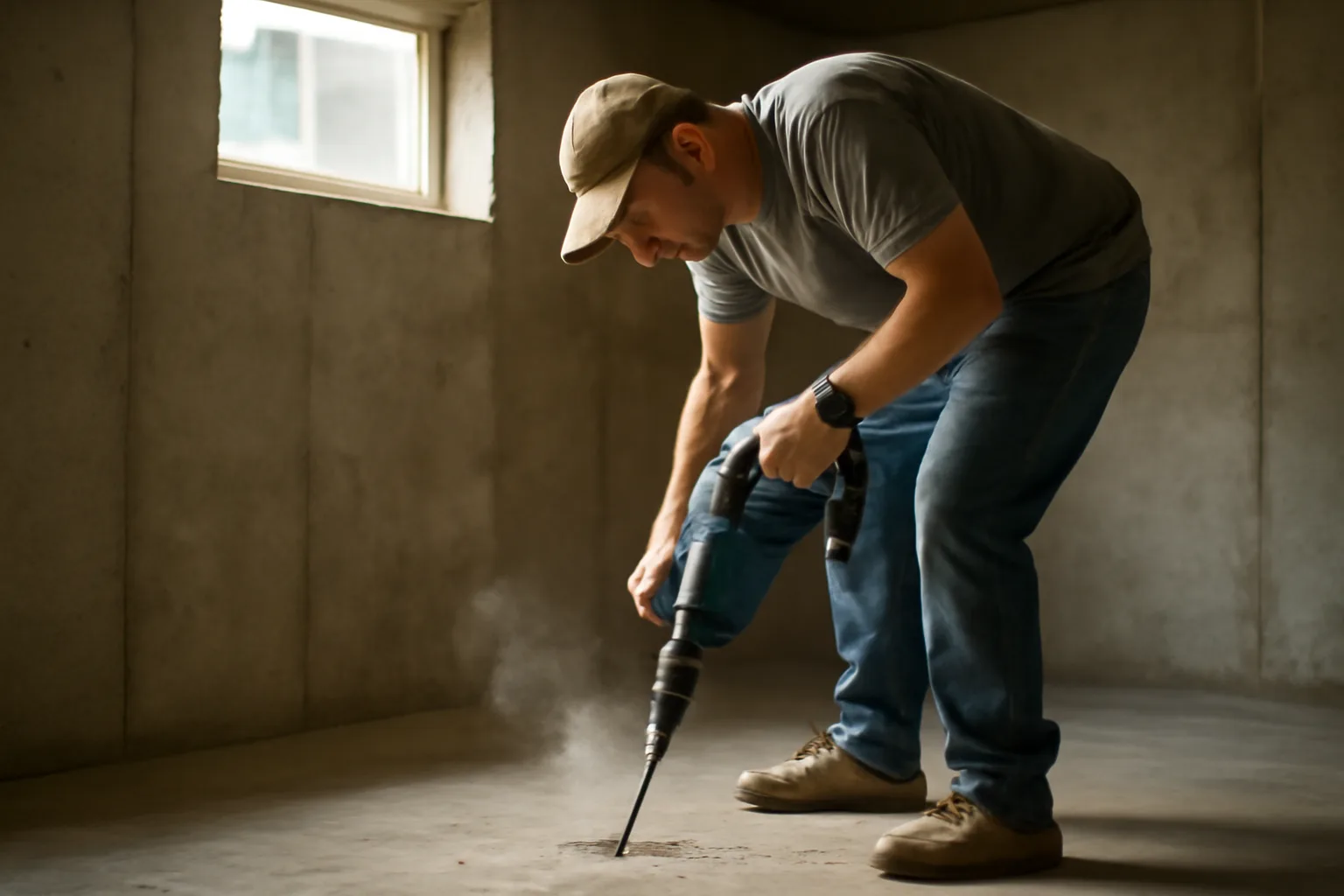
The physical installation for a standard sub-slab depressurization system takes four to eight hours for one technician. That covers core drilling through the slab, routing pipe to the fan location, installing the fan, penetrating the exterior wall or roof, sealing slab penetrations, wiring the fan if it needs a dedicated circuit, and installing the pressure field diagnostic gauge (the U-tube or digital manometer). [4]
More complex jobs, say a two-point install with a crawl space membrane, can run eight to twelve hours or require a second crew day. That's still not a multi-day project in most cases.
After installation, you need a post-mitigation radon test to confirm the system worked. EPA protocol recommends waiting at least 24 hours after the system is running before starting a short-term test, then running that test for at least 48 hours with closed-house conditions. [4] Results from an electret or charcoal-based short-term test come back in a few days once the lab processes them. So the full verification cycle from install to confirmed result is typically one to two weeks.
From the contractor side, if you're building a schedule: a competent one-person operation can realistically complete two installs per day on straightforward jobs. Allowing for drive time and job variation, three to four jobs per day is possible with a two-person crew in a tight service area.
For homeowners waiting on a quote or scheduling an install, the practical lead time in metro Denver is usually one to three weeks depending on contractor availability. Busy seasons (pre-sale real estate season in spring, and late fall before heating season locks people in) tend to back contractors up.
What Colorado-specific radon facts should contractors know?
Colorado is one of the higher-radon states in the country. The CDPHE reports that roughly 50 percent of Colorado homes tested show radon levels at or above 4 pCi/L, the EPA action level. [1] That's significantly higher than the national average of about 1 in 15 homes (roughly 6.7 percent) exceeding 4 pCi/L per EPA estimates. [6]
The geology explains it. Colorado's Front Range and much of the Western Slope sit on uranium-bearing granitic soils and rock. Uranium decays to radium, which decays to radon gas. The gas moves through soil and enters buildings through foundation cracks, sump pits, utility penetrations, and construction joints.
The EPA classifies counties into three zones. Zone 1 means a predicted average indoor radon level above 4 pCi/L. A large majority of Colorado's Front Range counties, including Denver, Boulder, Jefferson, El Paso, Arapahoe, Adams, and Larimer, are designated Zone 1. [7] That has direct business implications: demand is structural, not seasonal.
CDPHE does not license radon professionals but does maintain a list of certified professionals (those holding NRPP or NRSB credentials) as a public resource. Getting certified and listed there is free additional visibility. [1]
Colorado also follows the EPA's recommended radon mitigation standards (EPA 402/B-93/078 and subsequent guidance) rather than a separate state code. There's no state variance from federal protocol to memorize. [4]
What's the process to become a certified radon mitigator in Colorado step by step?
Here's the real sequence, no fluff.
Step one: complete an approved training course. NRPP maintains a list of approved course providers at aarst-nrpp.com. Look for a course that covers EPA mitigation protocol (the standards document), building diagnostics, fan selection, and system verification. Courses run 16 to 24 hours and are offered in-person and online. [3]
Step two: pass the NRPP or NRSB exam. NRPP's exam is computer-based and proctored. You schedule it after your course. Scores are typically available immediately or within a few business days. Confirm current exam fees directly with NRPP before you budget.
Step three: apply for NRPP or NRSB certification and pay the credential fee. Again, confirm current amounts with the certifying body. These fees change and we won't invent a number that might be wrong by the time you read this.
Step four: get a Colorado business license if you're operating as a business (standard requirement, not radon-specific). File with the Colorado Secretary of State's office if you're forming an LLC or corporation. [8]
Step five: get liability insurance. No state law mandates it for radon work in Colorado, but every real estate transaction you touch will expect it, and NRPP strongly recommends it. General liability coverage for a contractor in this trade typically runs $500 to $1,500 per year depending on your carrier and revenue.
Step six: list yourself on CDPHE's certified professional list. That requires submitting proof of your national certification to CDPHE. It's not a license, it's a directory listing, but it's the first place many Colorado homeowners look.
The whole timeline from starting a training course to having your credential in hand is typically four to ten weeks, depending on how quickly you schedule and pass your exam.
How does Colorado compare to states with mandatory radon licensing?
Colorado is a voluntary-certification state. Several states have gone further and require mandatory state registration or licensing to do radon mitigation work legally. The comparison matters if you're deciding where to operate or if you're coming from another state.
| State | Mandatory state license/registration? | Notes |
|---|---|---|
| Colorado | No | NRPP/NRSB voluntary; no state program |
| Alabama | Yes (ADPH) | State certification required [see note] |
| Alaska | No mandatory program | Voluntary NRPP/NRSB |
| Arizona | No mandatory program | NRPP/NRSB standard |
| Florida | Yes | State radon contractor licensing program |
| Illinois | Yes | IEMA certification required |
| Pennsylvania | Yes | DEP registration |
The practical difference: in Colorado, you can legally install a radon system without NRPP or NRSB certification. Nobody will arrest you. But you won't get on the CDPHE list, most home inspectors won't refer you, and most post-sale warranty scenarios will fall apart. The voluntary standard functions as a market requirement even without a law behind it.
If you're comparing Colorado's entry path to other states, see the radon mitigation license in Alabama guide and the radon mitigation license in Alaska guide for side-by-side comparisons of mandatory vs. voluntary states.
For contractors relocating to Colorado from a state with mandatory licensing: your existing NRPP or NRSB credential transfers. You don't re-test. You don't file a Colorado-specific application. That's a real advantage of the national certification system over patchwork state programs.
What equipment and materials does a Colorado mitigator actually need?
A complete first-kit setup for a Colorado mitigation contractor running sub-slab depressurization jobs includes the following. This list isn't exhaustive and costs shift, but it gives you a realistic starting budget.
Core tools: a rotary hammer drill (for slab penetration), a hole saw set for 3-inch and 4-inch PVC, a shop vacuum, and basic hand tools. A digital manometer (for pressure field diagnostics) is essential and not optional if you're following EPA protocol. The Sun Nuclear 1028 or similar digital units run $300 to $600.
Fans: most Colorado residential jobs use Radon Away, Festa Radon, or equivalent fans in the mid-range flow/pressure category. A RP145 or GP301 equivalent handles the majority of straightforward slab conditions. Fans typically run $80 to $200 each depending on model and vendor.
Pipe and fittings: standard Schedule 40 PVC, 3-inch or 4-inch diameter. Your local plumbing supply house will stock it. U-tube manometers for the diagnostic port run about $10 to $15 each.
Vehicle: most single-operator contractors in Colorado work out of a pickup or cargo van. You don't need a specialized rig at the start, just enough space for pipe, drill, a few fans, and safety gear.
Post-mitigation test kits: short-term charcoal or electret kits are required to verify your work. You can order them wholesale from labs and provide them to clients, or require clients to provide them. Keep this in your per-job workflow.
Total startup equipment budget for a minimal but functional setup: roughly $2,000 to $4,000. A fully outfitted first-year kit with redundant tools and a larger fan inventory runs higher.
What continuing education does Colorado require to maintain certification?
Because Colorado has no state program, continuing education requirements come entirely from whichever national certification body you hold credentials with.
NRPP requires recertification every two years. That means completing 16 continuing education credits (CECs) per two-year cycle and paying a recertification fee. The credits can come from approved courses, workshops, AARST conference attendance, or other NRPP-approved providers. Fail to recertify and your listing lapses, which matters because CDPHE's directory and NRPP's public lookup both show certification status. [3]
NRSB has a similar two-year recertification cycle with its own CE requirements. If you hold both credentials, the CE requirements are generally stackable, meaning one course can count toward both.
The CECs are not onerous. Most active contractors pick them up through AARST (the American Association of Radon Scientists and Technologists) annual symposium or regional workshops. Some manufacturers offer approved CECs through product training. [9]
One thing Colorado contractors should track: if the state ever moves to a mandatory program (which has been discussed in the legislature in past sessions but not enacted as of this writing), the transition rules often grandfather in active NRPP or NRSB holders. Staying current with your national credential protects you if that changes.
How do Colorado's radon levels affect demand for mitigation services?
The CDPHE tested indoor radon levels across Colorado and found that approximately 50 percent of homes tested exceeded the 4 pCi/L EPA action level. [1] The EPA's national estimate is roughly 1 in 15 homes, or about 6.7 percent. [6] Colorado's rate is dramatically higher.
The EPA's "A Citizen's Guide to Radon" states: "EPA recommends fixing your home if the results of one long-term test or the average of two short-term tests show radon levels of 4 pCi/L or higher." [6] That standard is the trigger point for virtually every mitigation job in the state.
For a contractor building a service territory, that 50 percent prevalence rate means roughly half of every home you test is a potential mitigation job. On the Front Range alone, there are hundreds of thousands of untreated homes. The market is not saturated in most Colorado communities outside of a few dense urban pockets where several established contractors operate.
Real estate transactions are the single largest demand driver. Colorado law doesn't require radon testing at sale, but many buyers and their agents request it as a condition. The real estate transaction pipeline feeds a predictable, year-round workflow that most Colorado mitigators depend on. Understanding that pipeline, and building relationships with inspectors and agents, matters more than any marketing spend in the first year.
For a broader look at how to build the first-year operation, the how to start radon mitigation in Colorado guide covers business setup, pricing, and finding your first clients.
Where should you go to get your NRPP certification and stay current in Colorado?
Start at aarst-nrpp.com for the official exam and credential process. NRPP is the certification arm of AARST (American Association of Radon Scientists and Technologists), which is the primary industry professional body in the US. [3][9]
For course providers, NRPP publishes an approved provider list. Some are Colorado-based and offer in-person sessions; others run online. There's no particular advantage to in-person vs. online if you're self-disciplined, and online lets you schedule around work.
The EPA's Indoor Air Quality resource page has the foundational documents you'll reference throughout your career: the mitigation standards, the consumer guide, the zone maps. Bookmark epa.gov/indoor-air-quality-iaq and epa.gov/radon as reference points. [2][6]
CDPHE's radon program page lists certified professionals and has state-specific testing data and maps. [1] Getting on that list after you're credentialed takes a simple submission of your certification documentation.
If you want a structured path through the prep materials before your NRPP exam, RadonPath's NRPP Mitigation Kit is built for exactly that stage. It's a $149 one-time resource, not a subscription, and you can start at /start.
For comparison with how neighboring states handle this, the radon mitigation license in Arizona guide and the how to start radon mitigation in California guide are worth reading before you decide where to build your business.
Frequently asked questions
Do you need a license for radon mitigation in Colorado?
No. Colorado has no state radon mitigation license or mandatory contractor registration program. The recognized standard is voluntary national certification through NRPP or NRSB, which requires passing a proctored exam after completing approved training. Most real estate transactions and inspector referrals expect that certification, making it a practical requirement even without a law behind it. Confirm with your local municipality, as city or county rules can vary.
How much does radon mitigation cost in Colorado?
The EPA's Consumer's Guide to Radon Reduction puts the typical cost of a residential mitigation system at $800 to $2,500, with most jobs under $1,500. In Colorado, straightforward Front Range slab homes with a single suction point land in that range. More complex installs with crawl spaces, multiple suction points, or interior fan placement push toward the upper end. Confirm quotes from at least two certified contractors before committing.
How long does radon mitigation take in Colorado?
A standard sub-slab depressurization install takes four to eight hours for one technician. More complex jobs with multiple suction points or crawl space membrane sealing can run eight to twelve hours. After the system runs for at least 24 hours, a post-mitigation short-term test runs for 48 hours minimum. The full cycle from install to confirmed results is typically one to two weeks.
Is NRPP certification recognized in Colorado?
Yes. NRPP (National Radon Proficiency Program) certification is the primary credential the Colorado Department of Public Health and Environment uses to populate its certified professionals directory. It's also the credential most real estate agents, home inspectors, and sophisticated buyers check. NRSB certification is equally recognized. Either credential works; holding both is not required but some contractors maintain both.
Does Colorado have a state radon office or program?
Yes. The Colorado Department of Public Health and Environment (CDPHE) runs a radon program that maintains testing data, publishes county-level radon zone maps, and lists certified radon professionals. It does not issue state radon licenses or registrations. Its role is education, data collection, and maintaining the public directory of NRPP/NRSB-certified contractors.
What percentage of Colorado homes have high radon levels?
CDPHE data shows approximately 50 percent of Colorado homes tested have radon levels at or above the EPA action level of 4 pCi/L. That's far above the national average. The elevated levels stem from Colorado's uranium-bearing granitic geology, particularly across the Front Range and Western Slope. For contractors, this creates consistent structural demand across nearly every service territory in the state.
How do I get on CDPHE's certified radon contractor list in Colorado?
Earn your NRPP or NRSB mitigation certification, then submit proof of that certification to CDPHE's radon program. CDPHE does not issue its own credential; the list is a directory of contractors who hold nationally recognized certifications. There is no state application fee for the listing. Contact CDPHE's radon program directly to confirm the current submission process, as procedures can change.
Can I do radon mitigation in Colorado without NRPP certification?
Legally, yes. Colorado has no law prohibiting uncertified work. In practice, you'll be excluded from the CDPHE contractor list, real estate agent referral networks, and any work where a buyer's agent or inspector is involved. Liability exposure is also higher without the credential. Treating NRPP or NRSB certification as mandatory, even though the state doesn't, is the rational business decision.
How often does NRPP certification need to be renewed in Colorado?
NRPP requires recertification every two years. That means completing 16 continuing education credits per cycle and paying a recertification fee. Credits are available through AARST events, approved workshops, and some manufacturer training programs. Because Colorado has no state program, there's no separate state renewal. Your NRPP credential is your only credential to maintain. Let it lapse and your CDPHE listing and public directory status both go dark.
What's the difference between radon mitigation and radon measurement certification?
NRPP offers separate exam tracks for measurement and mitigation. Measurement certification covers testing protocols, device placement, and result interpretation. Mitigation certification covers system design, installation, fan selection, and post-installation verification. Many contractors in Colorado hold both, which lets them test, install, and verify without referring out. You can start with either track; mitigation-only is the most common entry point for contractors focused on installs.
Does Colorado require radon testing before selling a home?
No. Colorado has no law requiring radon testing as a condition of home sale. Testing is typically requested by buyers or their agents as part of the inspection contingency. Many Colorado real estate transactions do include radon testing because of the state's high radon prevalence, but it's negotiated between buyer and seller rather than mandated by law. Some lenders may require it independently.
What EPA zones cover Colorado counties?
The EPA divides counties into three radon zones. Zone 1 predicts average indoor radon above 4 pCi/L. Most Front Range counties, including Denver, Boulder, Jefferson, El Paso, Arapahoe, Adams, and Larimer, are Zone 1. Many mountain and Western Slope counties are also Zone 1. A few eastern plains counties fall in Zone 2 (2 to 4 pCi/L). Colorado has very few Zone 3 counties. Check the EPA zone map for the specific county you're targeting.
How much does it cost to become a certified radon mitigator in Colorado?
Budget roughly $500 to $900 for an approved training course, plus the NRPP exam fee and certification fee (confirm current amounts at aarst-nrpp.com, as fees change). Add $500 to $1,500 per year for liability insurance and $2,000 to $4,000 for basic startup equipment. Total first-year entry cost for a minimal operation typically runs $5,000 to $10,000 before you factor in vehicle costs or marketing. Confirm all current fees directly with NRPP.
How does Colorado's radon licensing compare to states like Alabama or Florida?
Colorado is a voluntary-certification state with no mandatory license. States like Alabama and Florida have mandatory state registration or licensing programs with separate applications, state fees, and state-specific renewal requirements. In practice, the NRPP credential transfers across all states, so Colorado mitigators moving to a mandatory state need to apply for that state's program while already holding the underlying national credential. See the radon mitigation license in Alabama guide for a direct comparison.
Sources
- Colorado CDPHE, Radon Program: Colorado has no mandatory state radon contractor licensing program; CDPHE maintains a directory of NRPP/NRSB-certified contractors and reports approximately 50% of Colorado homes tested exceed 4 pCi/L
- AARST-NRPP, Mitigation Certification: NRPP mitigation certification requires completing an approved training course and passing a proctored exam; recertification is required every two years with 16 continuing education credits
- U.S. EPA, Radon Mitigation Standards (EPA 402/B-93/078): EPA mitigation standards govern system design, installation protocols including post-mitigation testing requirements and the 24-hour minimum system run time before starting a post-test
- U.S. EPA, Consumer's Guide to Radon Reduction: Typical cost of reducing radon in an existing home is $800 to $2,500, with most falling below $1,500
- U.S. EPA, A Citizen's Guide to Radon: EPA recommends fixing a home if radon test results show 4 pCi/L or higher; national estimate is about 1 in 15 homes exceeds this level
- U.S. EPA, EPA Map of Radon Zones: Most Front Range Colorado counties including Denver, Boulder, Jefferson, El Paso, Arapahoe, Adams, and Larimer are EPA Zone 1, predicting average indoor radon above 4 pCi/L
- Colorado Secretary of State, Business Filing Center: Contractors operating as a business entity in Colorado must file with the Colorado Secretary of State
- AARST, American Association of Radon Scientists and Technologists: AARST provides approved continuing education credits through annual symposium and approved workshops that satisfy NRPP recertification requirements