Last updated 2026-08-19
TL;DR
Radon mitigation is the trade of lowering indoor radon, usually with a fan-powered soil suction system and a post-install test. You start by reading your state board's accepted credentials (often NRPP or NRSB mitigation, sometimes a state license), then you train, test, and build a measurement-first job file. EPA treats 4 pCi/L as the action level. There is no single national license. Confirm fees and forms with the board that prints your card.
What is radon mitigation?
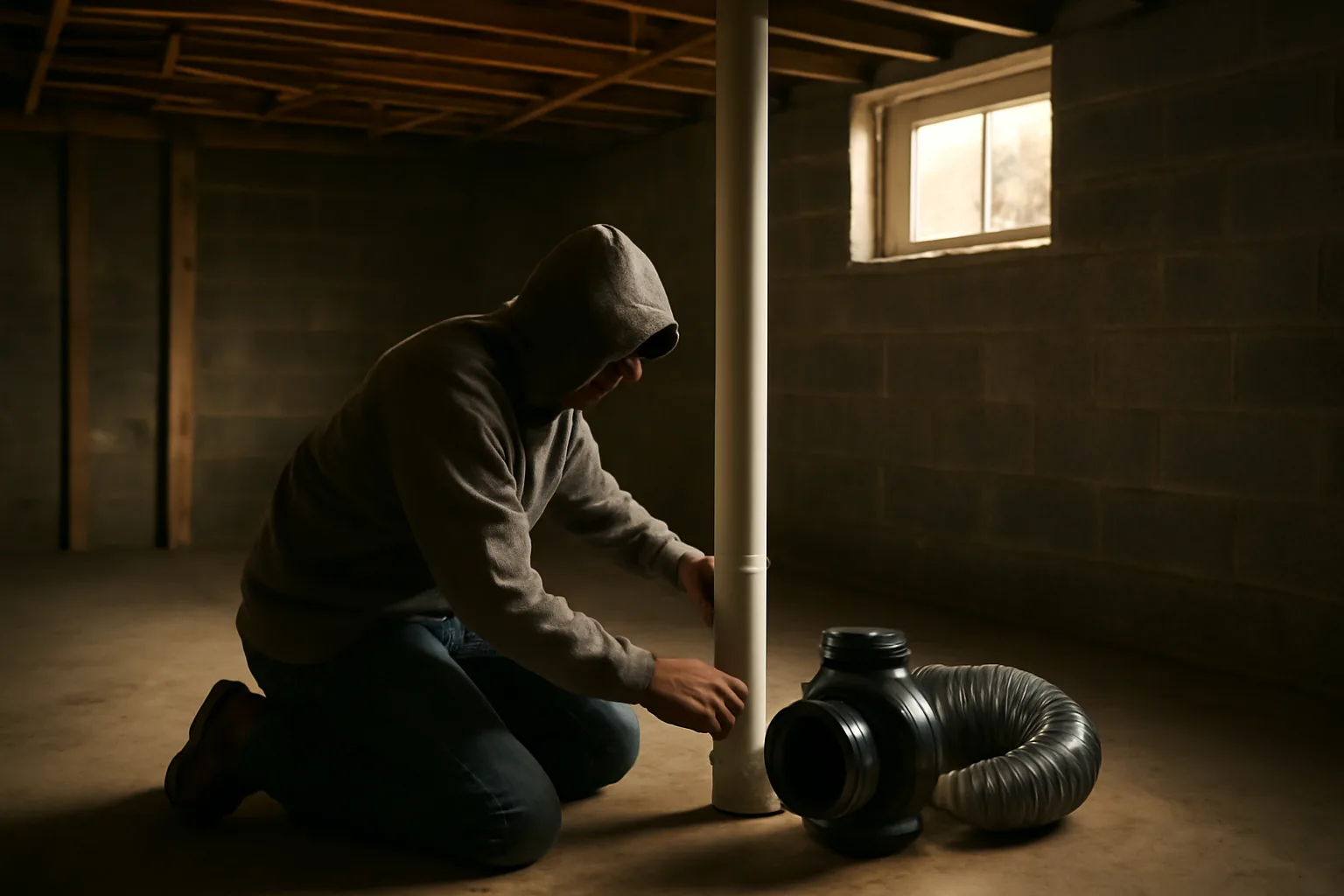
Radon mitigation is the work of lowering indoor radon gas so a building sits under the number your client, the contract, and the local rules care about. In most houses that means active soil depressurization. You open a suction point into the material under the slab or under a sealed crawl-space membrane, you run pipe to a continuously running fan, and you discharge the soil gas above the roof.
That is the job. The rest is sealing, diagnostics, and paper.
EPA's Consumer's Guide to Radon Reduction describes soil suction as the usual method in existing homes, and it tells readers a trained contractor should handle design when the house is not a simple, obvious layout. [1] CDC says radon forms from the natural breakdown of uranium in soil and rock and can collect indoors. [5] WHO states that radon is the most important cause of lung cancer after smoking. [4]
You are not scrubbing room air. You are changing pressure. The fan makes the soil side a bit more negative than the house, so soil gas prefers the pipe over the slab cracks. A U-tube manometer on the riser shows the system is pulling. A post-mitigation test shows whether the living space actually dropped.
I would not sell ozone boxes or mystery filters as mitigation. They do not replace a soil pipe. If a client wants extra ventilation in a tight house, bid it as ventilation, not as a radon cure.
Testing is not mitigation. Some states split the cards. Hold both credentials, or put a lawful tester on the file for the pre-test and the post-test. Do not invent a number. If you want a side-by-side of this trade against nearby work, read radon mitigation vs nearby career.
How do you start radon mitigation?
You start by finding the state radon office (or confirming your state has none), reading the exact credential that office lists, then finishing that path before you advertise a fan. Often that is NRPP mitigation, NRSB mitigation, a state license, or a mix. Then you write a measurement-first job process and buy diagnostics before you buy vinyl lettering.
There is no federal contractor license. The Indoor Radon Abatement Act set a national health goal. It did not print you a card. [6]
Do this in order. One, read the statute or rule page for the state where you will take money. Two, list the accepted exams and any state application on top of the national exam. Three, sit the approved course and the exam the board names. Four, add the local pieces boards forget to mention in blog posts: a business registration, a building or electrical permit habit, and a written contract. Five, run a few diagnostic-only visits before you guarantee a number.
Skip the national myth that "NRPP means you can work anywhere tomorrow." Some states treat that card as the license. Illinois does not. New Jersey does not. Florida puts radon duties in statute and runs its own program. [8] [11]
Confirm every fee, form name, and renewal cycle with that board. Nobody writing a national article can quote your current invoice. Processing times move. I will not invent one.
If you like checklists, print them from the certifying body and the state site. Spend cash first on a micromanometer you will actually use. A longer walk-through of early paper lives in radon mitigation guide 12.
What radon number actually triggers a job?
EPA tells people to fix a home at 4 picocuries per liter (pCi/L) or higher. That is the number you will hear in real estate and on most consumer pages. EPA also says to consider a fix between 2 and 4 pCi/L. [2]
The federal action level is one line you will repeat all day: "fix your home if your radon level is 4 pCi/L or higher." EPA sets it. [2]
WHO uses a reference level of 100 Bq/m3, which is about 2.7 pCi/L. [4] So a house at 3.2 pCi/L is under EPA's action level and over WHO's reference. That is not a trick question. It is why your contract has to name the target, the test method, and who pays if the first design misses.
EPA estimates radon causes about 21,000 U.S. lung cancer deaths each year. [2] That figure is why buyers ask for a system at 4.0 and why some clients want 2.0. You still need a lawful test on the file. A gadget on a phone app is not a closed-building measurement.
I bid to a written post-test protocol, not to a vibe. Short-term tests are common after install. Long-term tests tell a better seasonal story. Follow the measurement standard your state named, not a Facebook group.
4 pCi/L equals 148 Bq/m3. Write both units on the first page of the report if your client is coming from a European listing or a lab that prints SI units. More number-handling notes sit in radon mitigation guide 18.
Do you need a license, or is a national card enough?
It depends on the state, and the only honest answer is the page your board publishes this year. A national NRPP or NRSB mitigation credential is often necessary. It is not always sufficient. In a state with no radon contractor license, you can still need a business registration, a permit for the fan circuit, and a roof penetration that the inspector will actually pass.
Illinois licenses the radon industry under the Radon Industry Licensing Act (420 ILCS 44). You do not get to skip that because you passed a national exam. [7] New Jersey requires certification for testers and mitigators through DEP. [11] Florida puts radon notice and program duties in section 404.056, Florida Statutes, and runs a state certification path. [8]
Plenty of states still have no specialty radon license. That is not a free pass. Homeowners sue. Insurers ask for a credential anyway. Building departments still own the electrical disconnect and the exterior pipe.
| Path | Who issues it | What it usually covers | What it does not do |
|---|---|---|---|
| National NRPP mitigation | NRPP | Course plus exam many states accept | Replace a state license where one exists |
| National NRSB mitigation | NRSB | Alternate national exam path | Replace a city permit or electrical inspection |
| State license or certification | State radon office | Legal right to sell the work in that state | Travel automatically to the next state |
| Building or electrical permit | City or county | Legal fan circuit and penetrations | Prove the indoor radon number dropped |
I would not advertise in a licensed state on a national card alone. Read the statute. Then call the board and ask them to email the application checklist. Save that email.
What training and exams do boards usually accept?
Most boards that care will name NRPP, NRSB, or their own exam. NRSB publishes its own certification path and is one of the two national names you will see on state lists. [13] The other path is NRPP, a course plus an exam, not a weekend video and a handshake.
EPA's standards-of-practice page points to the current ANSI/AARST consensus standards rather than a homemade shop method. [10] For existing houses, that usually means the soil-gas mitigation standard for single-family buildings. Buy the standard. Do not learn discharge height from a parts catalog.
I would take a live or proctored course that includes diagnostics, combustion-appliance backdrafting, crawl-space membranes, and drain-tile systems. Houses are not all slabs with a sump. The cheap course that skips pressure field extension will cost you a failed post-test and a second mobilization.
Measurement training is a separate decision. If your state splits the licenses, decide on day one whether you will test or subcontract tests. Subcontracting is fine. Losing the chain of custody is not.
Confirm CE hours, device approval lists, and photo ID rules with the body that will print the card. Those details change. A national blog that quotes a 2019 hour count is a waste of your time. Course logistics also show up in radon mitigation guide 30.
What does the first-year truck actually need?
You need diagnostics, pipe, a known radon fan line, sealants, and a way to leave a manometer the homeowner can read. You do not need a wrapped sprinter and four spare fans before job three.
Buy a good micromanometer, a simple U-tube you can leave on the pipe, a shop vac for diagnostic suction, a hammer drill and core bits you can replace, PVC and couplings, a couple of fans from a radon-specific line, fire-stop materials that match the penetration, and a combustion-gas sense plan if the house has atmospherically vented appliances. Backdrafting is how a "simple radon job" becomes a CO problem.
Skip the inventory of decorative rock covers until a client pays for one. Skip four-color brochures. Skip any gadget that claims to eat radon in the room air.
RadonPath sells a $149 one-time NRPP Mitigation Kit if you want NRPP-oriented paper in one pile. You can also print the same checklists from NRPP and your state site and put the $149 into the better meter. I would buy the meter first.
First year is ugly. You will guess a pit location wrong. You will return. Budget time and pipe for that, not a trade-show booth. A tighter gear list sits in radon mitigation guide 48.
How much does a residential system cost?
EPA's still-posted Consumer's Guide says a typical system runs about $800 to $2,500, with an average near $1,200. [1] Treat that as a published federal range, not as your 2026 bid.
Nobody has a clean national average I trust for this year. Labor, roof height, block-wall suction, crawl-space membranes, and electrical upgrades move the number. In many metros the street price is higher than that EPA pamphlet. In a simple slab ranch with an existing sump, you can still land near the old range. Confirm with local bids, not with a national myth.
Your cost to install is not the client's price. Count permit fees, a second trip for a failed pressure field, mileage, and the post-test. If you forget the second trip, you will hate the "cheap" job.
I would not lowball to "get reviews." A fan on a wet crawl with a bad membrane is how you buy a callback season. Bid the membrane. Bid the electrical. Bid the roof flashing. Write the exclusions.
Commercial and multifamily work is a different standard and a different insurance conversation. Do not use a house price to bid a wing of apartments. EPA's published $1,200 average is a consumer figure for a home, not a school.
What paper belongs in every job file?
Every file needs a signed scope, the pre-test, a simple floor sketch, diagnostic notes, photos of the suction point and the roof discharge, fan model and serial, the install manometer reading, any permit, the post-test, and the warranty terms. If a device was used, keep its serial and the last calibration date the program requires.
That pile is how you survive a complaint. Memory is not a record.
Boards that license the work will name extra forms. Illinois, New Jersey, and Florida do not use the same PDF. [7] [8] [11] Confirm the current packet. Do not photocopy a form you found on a forum.
Write the target level in the contract. Write who pays for a redesign if the first suction point cannot move the house. Write whether the post-test is short-term or long-term. Write that the fan is a wear part.
I keep photos like I am going to explain the job to a stranger in two years. Because that is exactly what a complaint is.
Label the manometer so a homeowner can see a lost vacuum. A dead fan with no warning is how indoor levels creep back while everyone assumes the system is still working. File habits continue in radon mitigation guide 60.
How do you design a simple slab system without guessing?
You test first, you map the slab, you pick a suction point you can actually reach (sump, dedicated pit, or drain tile if it is truly connected), you prove a pressure field, then you size the fan to the soil, not to the marketing name on the box.
A sump with a sealed lid is a gift when the drain tile is real. It is a trap when the "tile" is three feet of gravel and a wish. Run a diagnostic. A shop-vac test and a few communication holes tell you more than a catalog curve.
Discharge above the roof, away from openings, at the height the standard and the local inspector both accept. [10] Do not hide a fan in a dark crawl and dump under a soffit because it was pretty. Short-circuiting the exhaust back into an eave is a classic miss.
Seal the big holes. You will not caulk a whole house airtight, and you should not claim you did. Close the open dirt, the unused chase, the obvious slab plumbing penetrations. Then measure again.
I still walk combustion appliances after the fan is on. If a water heater spills, you do not leave. You fix the pressure problem or you shut the job down and call the right trade. That is not optional politeness. It is how you avoid harming people while chasing a radon number.
What do you do when the post-test is still high?
You treat it as a design problem, not as a client attitude problem. Recheck the manometer, the discharge, the sealed sump lid, and whether someone opened the house during the test. Then go back to diagnostics.
A still-high house often needs a second suction point, a different fan curve, wall suction on a hollow block foundation, or a crawl membrane you tried to skip. Sometimes the first test was a fluke of weather. Sometimes the soil will not communicate ten feet. You do not know until you measure.
Say that in the original bid. "One pit, one fan, one mobilization" is how new operators go broke. I write a diagnostic revisit into the process even when I hope I will not use it.
If the system is pulling hard and the house is still high, look at indoor sources next: well water in rare cases, a granite-heavy sunroom that nobody mentioned, or a neighbor's discharge. Those are uncommon. Do not leap there to avoid cutting a second hole.
Document every change. The second post-test is part of the same job file, not a new myth about the house being "unfixable." Almost every house can get under 4 pCi/L. Some cost more pipe than the first quote.
What first-year mistakes waste the most money?
Buying branding before diagnostics. Bidding crawl spaces like slabs. Skipping permits. Guaranteeing 2.0 pCi/L on a house you have not drilled. Hiring a helper who cuts a roof jack with no flashing plan. Those are the expensive ones.
The other waste is collecting four state applications you will not use this year. Pick the state where you already have work. Get legal there. Then expand.
I would not spend early cash on a franchise story or a "territory." The work is local soil and local inspectors. A laminated mission statement does not move a pressure field.
Underinsuring is a quiet waste. A fan that backdrafts a furnace is not a small claim. Talk to an agent who has written radon or specialty contractors before. I cannot quote your premium. Anyone who can, without your address and crew size, is guessing.
Training on YouTube instead of the standard is also a waste. The ANSI/AARST documents EPA points to exist so you stop inventing discharge rules. [10] Read them once with a highlighter. Cheaper than a reroof.
How do you stay legal after the fan is on?
You renew the credential the board named, you keep device calibrations current if you measure, you pull the next permit the same way you pulled the first, and you do not let a helper start selling systems under your number without the card the statute requires.
National certifications expire. State cards expire on a different day. Put both on a calendar. A lapsed card turns a normal callback into an illegal job.
If you add a second state, repeat the whole read. Reciprocity is a word people like. The actual rule is whatever that second board printed. New Jersey will not care that Illinois already knows you. [7] [11]
Keep the manometer on the pipe. Teach the homeowner what a dead vacuum looks like. A system that ran for a year and then sat silent is how indoor levels return while the sticker on the pipe still looks official.
No article can promise approval or a processing date. Confirm renewals with the board. If the site is down, call. Save the name of the person who answered.
Where should a new operator read next?
Read the EPA Consumer's Guide so you hear the same numbers your clients hear. [1] Read EPA's health risk page for the 4 pCi/L action level and the 21,000-death estimate you will be asked to explain. [2] Read your state statute or program page next, then the NRPP or NRSB certification page that matches your path. [13]
Then read the mitigation standard EPA's practice page points to, not a vendor brochure. [10]
For more field paper in this series, use radon mitigation guide 72. RadonPath is an independent publisher, not a law firm and not a mitigation company. If you want the kit checkout after you have the board list in hand, use /start. Then confirm every fee with the office that will print the card.
Frequently asked questions
What is radon mitigation?
It is the work of lowering indoor radon, usually by pulling soil gas from under a slab or a sealed membrane and venting it above the roof with a continuous fan. You measure first, install, then post-test. Sealing helps. Room-air gadgets do not replace soil suction. EPA describes soil suction as the common method in existing homes.
How do you start radon mitigation?
Read the state radon office rules for where you will take money. Complete the credential that office lists, often NRPP or NRSB mitigation plus any state application. Write a measurement-first job file. Buy diagnostics before branding. Confirm fees and forms with the board. There is no single national license and no honest nationwide processing time.
Is radon mitigation the same as radon testing?
No. Testing measures the gas. Mitigation changes the building so the number drops. Some states put those tasks on separate cards. You can hold both, or you can subcontract lawful tests. A mitigation file still needs a real pre-test and post-test. Do not treat a phone app as a closed-building measurement.
Can a homeowner install their own radon system?
Some states allow DIY. Others restrict paid or even unpaid mitigation to licensed people. Even where DIY is legal, the electrical disconnect, roof flashing, and combustion-appliance check still matter. A wrong discharge can feed gas back indoors. I would tell a handy owner to read the state rule first, not a parts page.
How long does a mitigation fan last?
A continuous radon fan is a wear part. Many last several years. Some die earlier. Nobody should promise a decade without a warranty document from the maker. Leave a manometer so a dead fan is obvious. Budget a replacement in the homeowner conversation so the callback is a parts job, not a fight.
Do you need a measurement license if you only mitigate?
In split-license states, yes, unless a licensed tester runs the pre-test and post-test on the file. In unlicensed states, buyers and attorneys still expect a defensible measurement. I would not mitigate on a verbal "the realtor said it was high." Put a real test in the folder.
What is a U-tube manometer for?
It is the simple liquid gauge on the suction pipe. It shows the system is pulling vacuum. Homeowners can see a failure without a meter. It does not replace a post-mitigation radon test. Vacuum can look fine while indoor air is still high if the pressure field never reached the far rooms.
Does a radon system add much to the electric bill?
A continuous fan uses electricity every hour. The exact bill depends on the fan wattage and local rates. EPA's consumer materials treat operating cost as real but usually modest next to the install price. Quote the fan's rated watts. Do not invent a monthly dollar figure for a city you have not priced.
What is a pressure field extension test?
It is how you prove the suction point is actually influencing the soil under the slab or membrane. You measure small pressure changes at other holes. If the far corner does not move, one pit will not fix the house. This is the diagnostic new operators skip, then they pay for a second mobilization.
Can you mitigate a crawl space the same way as a slab?
No. A crawl usually needs a sealed membrane, sealed penetrations, and suction under that membrane. Treating bare dirt like a slab is a common failed post-test. Bid the liner, the tape, and the time. A sump-only pipe in an open crawl is not a system.
Are air purifiers a substitute for radon mitigation?
Not for the job you are being paid to do. Radon is a gas. Soil suction changes the entry path. A room filter may catch some particles, including a fraction of radon decay products, but it is not how EPA describes fixing a house. I would not sell one as mitigation.
How do you bid a house you have not seen?
You do not give a hard number. You can give a range after photos of the foundation type, sump, crawl, roof, and panel. Then you hold a site visit before you lock the price. Hidden block walls and wet crawls are where unsigned ranges become losses. Write the exclusions.
What insurance do new mitigation firms carry?
Talk to an agent who has written specialty contractors. General liability is the usual start. Ask about completed operations and whether measurement work is excluded. I cannot quote a premium from here. Anyone who can, without your address and crew, is guessing. Confirm with the carrier, not a forum.
Sources
- U.S. EPA, Consumer's Guide to Radon Reduction: Soil suction is the usual method in existing homes; EPA publishes a typical cost range of about $800 to $2,500 with an average near $1,200.
- U.S. EPA, Health Risk of Radon: EPA uses 4 pCi/L as the action level, says to consider a fix between 2 and 4 pCi/L, and estimates radon causes about 21,000 U.S. lung cancer deaths per year.
- World Health Organization, Radon and health fact sheet: WHO identifies radon as the most important cause of lung cancer after smoking and sets a reference level of 100 Bq/m3.
- CDC, About Radon: Radon comes from the natural breakdown of uranium in soil and rock and can collect indoors.
- 15 U.S.C. § 2665, Indoor Radon Abatement Act national goal: Federal law states the national long-term goal that indoor air should be as free of radon as outdoor air.
- Florida Statutes § 404.056: Florida statute 404.056 sets radon program and notice duties and supports the state's certification framework.
- U.S. EPA, Radon Standards of Practice: EPA identifies current ANSI/AARST consensus standards as the radon standards of practice.
- New Jersey DEP, Certification information for radon testers and mitigators: New Jersey requires certification for radon testers and mitigators through DEP.
- NRSB, Certification: NRSB is a national certification body that state boards may list for testers and mitigators.