Last updated 2026-08-20
TL;DR
Radon mitigation lowers indoor radon, usually by pulling soil gas from under a slab and venting it above the roof. Start on paper: check your state's rules, take an accepted course, pass the exam, and apply for a license only if your board requires one. EPA recommends fixing homes at 4 pCi/L or higher. Always post-test. Confirm current forms and fees with the board that regulates you.
What is radon mitigation?
Radon mitigation is the set of building fixes that lower indoor radon. In most houses that means a fan pulling soil gas from under the slab or a crawl space and dumping it above the roof so it never reaches living space.
That is the whole job in one sentence. The gas forms in soil from the uranium decay chain. It moves with pressure. A house sitting under suction relative to the soil pulls that gas in through cracks, sumps, and cold joints. You reverse the pressure field.
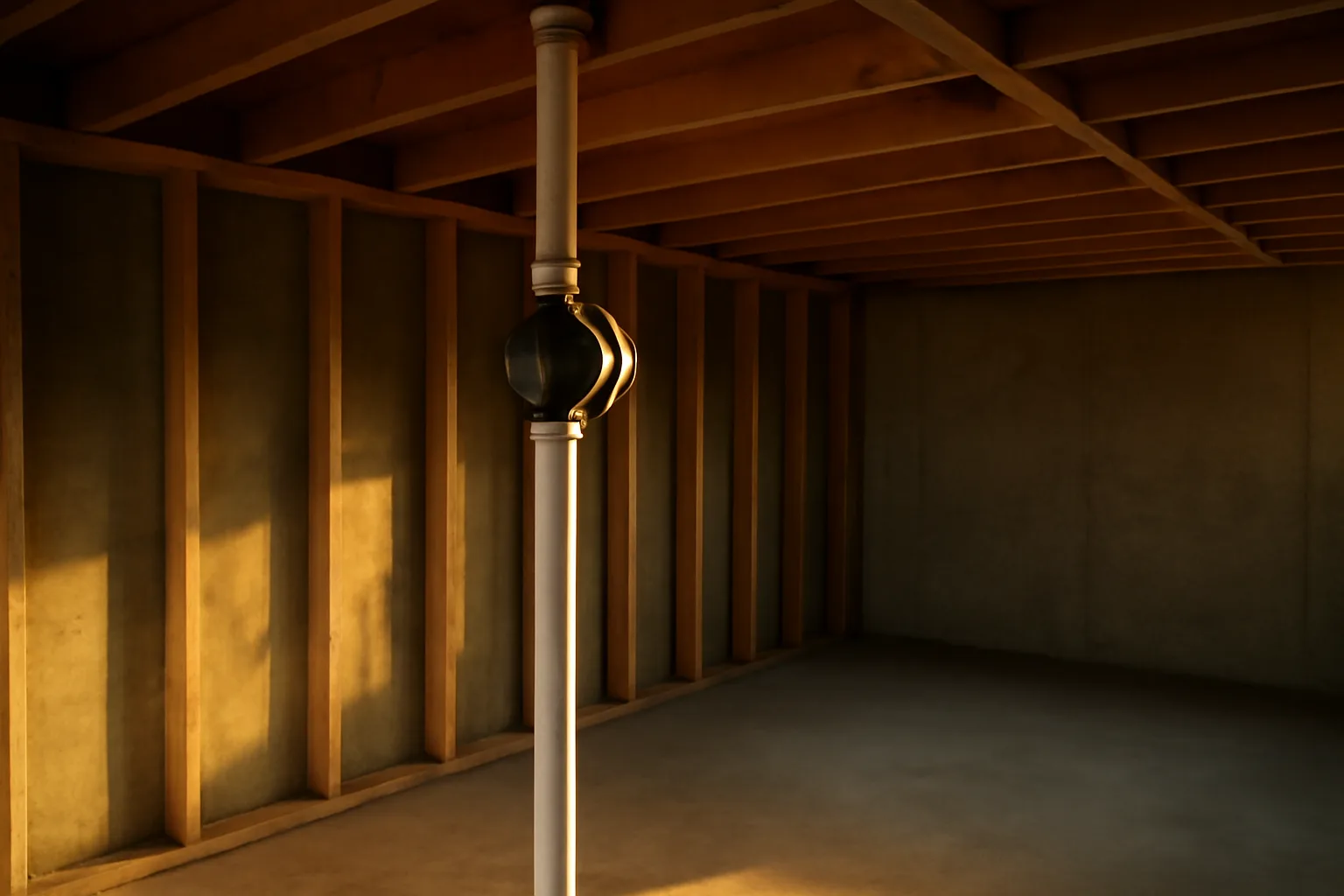
The common system is active soil depressurization. People call it SSD when the suction point sits under a concrete slab. You seal the big openings, drop a pipe to the sub-slab, hang an in-line fan, and run the exhaust above the eave. A U-tube manometer on the riser shows the homeowner the fan is still pulling.
EPA treats radon mitigation as a home repair with a measured result. The Indoor Radon Abatement Act wrote a national goal into federal law: "the air within buildings in the United States should be as free of radon as the ambient air outside of buildings" (15 U.S.C. 2661). [7] Nobody hits outdoor air in every house. You still design to get well under the number the homeowner cares about.
Other methods exist. Crawl-space membranes with suction. Block-wall depressurization on some block foundations. Ventilation that dilutes indoor air. I would not lead with dilution on a hot basement. Fix the soil gas path first.
If you are entering the trade, read this as pressure work plus proof. Not as a gadget catalog.
How do you start radon mitigation?
You start on paper, not with a truck wrap. Confirm whether your state licenses the work. Take a mitigation course the national program or the state will accept. Sit the exam. Apply for the state credential if one exists. Then buy tools.
That order saves money. People buy fans and a core drill first. They still cannot legally advertise in a license state.
Call the state radon office listed through Kansas State University's National Radon Program Services and ask what credential they want this year. [10] Rules move. Confirm with the board. Do not trust a random forum for the current form.
Course work is usually a multi-day mitigation class, plus a measurement class if you will also test. NRPP publishes a new-applicant path for Mitigation Specialist. [13] Some states ignore NRPP and run their own exam. Some accept NRSB. Some accept both. Get that answer from the board. Do not invent a fee or a wait time from memory. Read the live page.
Insurance and a local business license come next. A lot of cities also want a mechanical or building permit for the slab penetration and the exterior pipe. Ask the building department before you cut.
Then do diagnostics on real houses. Smoke. A micromanometer. Communication tests between test holes. The standard you will be held to in serious work is the current ANSI/AARST soil gas mitigation standard for that building type. Buy the standard.
If you want a nearby-career comparison while you decide, radon mitigation vs nearby career is the honest version.
What radon level means you should mitigate?
EPA recommends fixing a home when the radon level is 4 pCi/L or higher. That is a public health recommendation, not a federal legal limit on a private house.
The Citizen's Guide states it plainly: "EPA recommends fixing your home if the radon level is 4 picocuries per liter (pCi/L) or higher." [1] EPA also says consider fixing between 2 and 4 pCi/L, because there is no known safe level.
WHO uses a reference level of 100 Bq/m3, which is about 2.7 pCi/L. [6] That gap confuses new techs. You will have clients who want 2.0. You will have real-estate deals that only care about 4.0. Write the target in the contract.
EPA estimates about 21,000 radon-related lung cancer deaths each year in the United States. [2] CDC and the National Cancer Institute treat radon as the second leading cause of lung cancer, after smoking. [5][11] That is why the number on the test report matters more than the look of the pipe.
| Benchmark | Level (pCi/L) | Named source |
|---|---|---|
| Typical outdoor air | 0.4 | EPA Citizen's Guide |
| U.S. indoor average | 1.3 | EPA Citizen's Guide |
| WHO reference (100 Bq/m3) | about 2.7 | WHO radon fact sheet |
| EPA fix recommendation | 4.0 | EPA Citizen's Guide |
Outdoor air sits near 0.4 pCi/L in EPA's typical figure. Average indoor air is about 1.3 pCi/L. [1] A post-mitigation result under 2.0 is a clean day. Under 4.0 is the usual real-estate pass. I aim under 2.0 when the house will let me.
Short-term tests need closed-house conditions. EPA's home measurement protocols spell out placement, duration, and what invalidates a test. [4] Read that PDF before you argue with a listing agent.
How much does a typical radon mitigation system cost?
EPA's consumer guide on radon reduction treats a usual system as comparable to other common home repairs and has long published typical national figures around $800 to $1,200, with about $1,200 used as an average on EPA materials. [3] Some EPA pages have used a slightly wider band. House design, foundation type, and finish work move the number. Treat the EPA figure as a public benchmark, not your bid.
Your price will move with run length, fan size, interior versus exterior pipe, and whether you have to open a finished ceiling. Crawl-space membranes cost more labor. Big buildings are a different standard and a different bid.
I would not promise EPA's average on the phone. Walk the house. Look at the sump. Look at the HVAC. Look at where the exhaust can terminate.
Operating cost is mostly fan electricity. I do not have a national study I trust for one kWh figure across every fan model, so I will not invent one. Read the wattage on the fan you actually hang and do the math for that utility rate.
Retests, fan replacement, and the occasional extra suction point are the long-term costs. Tell the homeowner that up front.
If you are pricing your own first jobs, price materials, permit, drive time, and a post-test. Cheap jobs that skip diagnostics are how you get callbacks at 6 pCi/L. For more on early money decisions, radon mitigation guide 12 sits in this same series.
Do you need a license to do radon mitigation?
Sometimes. There is no single federal license that lets you mitigate in every state.
Illinois requires radon industry licensing under the Radon Industry Licensing Act, 420 ILCS 44. [9] Florida statute 404.056 directs environmental radiation standards, a radon program, and certification tied to measurement and mitigation work. [8] New Jersey, Ohio, Pennsylvania, Iowa, and others run their own lists. Other states have no radon-specific license at all.
I will not pretend I can give you a 50-state matrix that stays true next quarter. Confirm with the relevant board. Kansas State's radon services site is the practical directory for who to call. [10]
Even in an unlicensed state, you can still run into local permits, advertising rules, and liability. EPA tells the public to use a qualified professional and points people to state lists and national proficiency programs. [12]
If you work on federal or HUD-related housing, extra program rules can apply. Read the program paper. Do not assume a state card covers that scope.
Doing your own house is a different question. Many states allow a homeowner to work on their own occupied home. That exception usually dies the moment you charge a neighbor. Confirm that too.
What training and exams do new mitigators take?
Most new people take a classroom or online mitigation course that maps to NRPP or NRSB, then sit a written exam. If you will also sell tests, take the measurement course too.
NRPP's new-applicant pages describe the Mitigation Specialist route, including approved training and the exam sequence. [13] I will not quote a current fee or a processing time. Those change. Read the live page. Confirm with NRPP and with your state board.
Some states require their own exam even after you pass a national one. Some want a device listing. Some want a separate business listing and a named responsible individual. That last one matters if you hire helpers.
I would take the measurement class even if you plan to subcontract tests. You cannot design well if you cannot read a bad test.
Ride-alongs beat another certificate. If a shop will let you hold the vacuum and drill the test holes for a week, take it. radon mitigation guide 18 goes deeper on early field habits.
Waste of money: stacking three national credentials before your first paid slab. Get the one your board names. Add the second later if a client type demands it.
What does a sub-slab depressurization system include?
A simple SSD stack has a suction point through the slab, PVC pipe, an in-line fan rated for the static pressure you measured, a vent termination that meets the current standard, a manometer, the labels the standard requires, and seals at the big soil-gas openings.
That is the hardware. The work is the diagnostics. You prove a suction field before you walk away.
Sump pits get sealed lids with a planned pipe tap. Hollow block can leak like a chimney. Garage slabs and additions often need a second point. Crawl spaces usually want a sealed membrane and suction under the plastic, not a hopeful fan on a random corner.
Plenty of shops hang an undersized fan on a tight clay site and call it done. Check pressure at the far corners.
Electrical needs a disconnect and a legal circuit. I am not your electrician. Follow the code the inspector will use.
Termination location is where neighbors complain. Keep exhaust away from windows and air intakes. The current AARST/ANSI standard is stricter than folklore from 2005. Buy the current book.
radon mitigation guide 36 is useful if you are still sorting system types.
How do you prove a radon mitigation system worked?
You test. A pretty pipe is not proof.
Run a post-mitigation test after the system has operated long enough for the house to stabilize. EPA's home protocols cover device placement, closed-house conditions, and quality control. [4] Many shops use a continuous monitor so they can see diurnal swings.
Compare against the contract target, not against your feelings. If you promised under 4.0 and you printed 3.8, you met the paper. If the family wanted 2.0, you are not done.
Check the manometer with the homeowner standing there. Teach them what a dead U-tube looks like.
EPA tells people to retest after mitigation and to test again about every two years. [1] Put that on the handout. Fans fail. Occupants open sump lids. New additions punch the slab.
If the first post-test fails, do not immediately upsize the fan and invoice again. Re-run communication. Find the leak. Find the second foundation. Then change hardware.
A failed real-estate deal will pressure you to hang another fan. That is how you get two loud fans and a still-hot basement. Diagnostics first.
Document the device serial number, the start and stop times, and the house conditions. That file is what you will want when someone calls in eight months.
What paper should you keep in the first year?
Keep the pre-test, the contract, the diagnostic notes, photos of the suction point and termination, the fan model, the post-test, the permit, and the homeowner handout. If your state wants a notice of install, file it.
That packet is the job. The pipe is just the visible part.
I like a one-page field sheet: house address, foundation type, pre-level, suction at the pit, suction at the far test hole, fan model, manometer reading at handover, post-level. Nobody has a perfect national template. Make one and use it every time.
If you sell in a license state, keep the credential copies the board told you to carry in the vehicle. Confirm retention periods with that board. I will not invent a year count.
RadonPath publishes a $149 one-time NRPP Mitigation Kit aimed at this paper pile. You can build the same file from the EPA protocols and your state forms for free. Use whichever you will actually fill out.
Invoices should separate permit, labor, materials, and the post-test so a homeowner can see what they bought. radon mitigation guide 30 if you want more on first-year operations.
Which states regulate radon mitigation work?
A minority of states run a true license or certification for mitigators. The rest rely on general contractor rules, or on nothing radon-specific.
| Place | What the paper actually does | Confirm with |
|---|---|---|
| Federal | Goal and public guidance, no contractor card | 15 U.S.C. 2661 and EPA guides |
| Illinois | License for the radon industry | 420 ILCS 44 and the state radon office |
| Florida | Certification and mandatory standards | Fla. Stat. 404.056 and the state health program |
| States with no radon card | Business license and building permits only | State radon office plus the local AHJ |
Illinois names the work in 420 ILCS 44. [9] Florida puts the radon program and related certification in statute 404.056. [8] Several other states have long-running lists. I am not going to stamp a complete 2026 roster here because boards add fees, sunset rules, and device lists without asking writers first.
Confirm with the relevant board before you bid. Use the state contact list at National Radon Program Services. [10] Then read the statute or rule the clerk names. An agency homepage is not the rule.
Local building departments regulate the pipe and the electrical even when the state ignores radon. That is where most new techs get surprised. Call the AHJ.
Federal law set a goal, not a contractor card. 15 U.S.C. 2661 does not license you. [7] If you plan to work across a state line next year, treat each side as a new paper path. Reciprocity is uneven.
What should a new mitigator buy first?
Buy the standard, a micromanometer, a decent core drill you can handle, PVC tools, a quality fan line you understand, caulk and foam that actually stick to dusty concrete, a U-tube stock, and a continuous monitor if you will test your own work.
That list will get a simple ranch done. Everything else can wait.
Waste of money in year one: a wrapped sprinter, a thermal camera you cannot interpret, four fan brands sitting on a shelf, and any course that promises you will be fully booked after one weekend. Also skip paying for a second national credential before a state board has told you they want it.
I would rent a hammer drill before I owned three. I would not buy a crawler camera until I had lost a Saturday to a blocked pipe.
EPA's public pages and the KSU site are free. [3][10][12] Start there.
Safety gear is not a waste. Eye protection, hearing protection, and silica dust control when you cut concrete. Radon is not the only thing in that basement.
The radon mitigation guide 102 new techs actually need if you want a longer kit list.
How is radon mitigation different from HVAC or waterproofing?
It looks like HVAC or waterproofing. It is measured pressure work with a radioactive gas and a post-test that can kill the job.
Waterproofers seal water. You can seal every crack and still lose if the soil is open under the slab and you never pulled a field. HVAC techs think in indoor airflow. You think in small pressure differences under concrete.
The nearest cousin is other soil-gas work, including some vapor intrusion jobs. Those carry their own standards and often a different client, usually an environmental consultant rather than a listing agent.
Pay is job-based. Seasonality follows real estate in a lot of markets. Winter closed-house tests drive December panic. Nobody has good public data on average mitigator income that I would put a citation under, so I will not invent a salary.
Read radon mitigation vs nearby career before you quit a stable trade. Radon mitigation guide 108 for people starting the work stays on the first-year path if that is the decision you already made.
How do real-estate deadlines change a mitigation job?
They compress diagnostics and they tempt you to skip the post-test. Do not skip the post-test.
Listing agents want a clear number before closing. EPA still wants a valid measurement. [1][4] A two-day charcoal test under closed-house conditions is common in deals. Continuous monitors help when someone claims the house was open.
Write the contingency in the bid. If you cannot get a post-test before closing, say who is responsible for the result after the keys move.
I would rather lose a rushed job than hang a fan on Friday and pray.
Some buyers ask for a transferable warranty. Only write what you will honor. Fan warranties come from the manufacturer. Your labor warranty is your problem.
RadonPath is an independent publisher, not a law firm and not a mitigation company. If you want the kit checklist after you have read the statutes, use /start. This page still stands on the government paper if you never click it. radon mitigation guide 48 continues the series if you are working through these guides in order.
Frequently asked questions
What is radon mitigation?
Radon mitigation is the work of lowering indoor radon in a building, usually with a fan that pulls soil gas from under a slab or membrane and vents it above the roof. Sealing sumps and big openings is part of the same job. The proof is a post-mitigation test, not the look of the pipe. EPA treats it as a measured home repair.
How do you start radon mitigation?
Check whether your state licenses the work, then take a mitigation course that NRPP, NRSB, or that state will accept. Pass the exam. Apply for the state credential if the board requires one. Confirm current forms and fees with that board. Buy the current soil-gas standard and a micromanometer before you buy a wrapped van. Call the local building department about permits.
Is 4 pCi/L a law or just EPA advice?
It is EPA advice for the public, not a federal legal cap on a private house. EPA recommends fixing a home at 4 pCi/L or higher, and considering action between 2 and 4. Some states and housing programs write the number into their own rules. WHO's reference level is 100 Bq/m3, about 2.7 pCi/L. Put the target you are promising in the contract.
Can a homeowner mitigate their own house?
Often yes, if they live there and the state carves out an owner-occupant exception. That exception usually ends the moment they charge a neighbor or list the work as a business. License states still care about how the system is labeled and tested. Confirm the owner-occupant rule with the state radon office before you cut a slab for a friend.
Do I need NRPP if my state already licenses mitigators?
Only if that board says so. Some states accept an NRPP or NRSB exam as part of their own card. Some ignore the national programs and run a state exam. Some want both a national credential and a state listing. Read the live board page. Do not stack extra cards until a regulator or a real client type has asked for them.
How long does a simple house install take?
A simple slab ranch is often a one-day install plus a later post-test. Finished basements, crawl spaces, extra wings, and bad electrical add time. I will not give you a guarantee or a standard hour count. Walk the house, do the communication test, then schedule. The post-test is its own visit or device drop, not a free extra at 4 p.m.
What is a U-tube manometer and why do clients stare at it?
It is a simple liquid gauge on the riser that shows the fan is still pulling. Homeowners use it as the only daily check they have. A flat reading usually means a dead fan, an unplugged cord, or a broken tube. Teach that at handover. It is not a radon meter. Only a follow-up test proves the indoor level.
What test do you run after the fan goes in?
A post-mitigation radon test after the system has run long enough for the house to settle. Follow EPA home measurement protocols for placement and closed-house conditions. Many shops use a continuous monitor so they can see swings. Compare the result to the number in the contract. If it misses, diagnose the field before you hang a larger fan.
How often should a mitigated house be retested?
EPA tells people to retest after the system goes in and to test again about every two years. Fans fail. Occupants open sump lids. Additions punch the slab. Put that schedule on the homeowner handout. A manometer check is daily homework, not a substitute for a real measurement.
What permits show up on radon mitigation jobs?
Many cities want a building or mechanical permit for the slab penetration, the exterior pipe, and the electrical. That can be true even in a state with no radon license. Some license states also want a notice of install. Ask the local building department and the state radon office before the first core. Confirm fees there. Do not copy a number from an old blog.
What insurance do new mitigation shops usually carry?
Most shops carry general liability. Some general contractors or state programs want a named limit or an extra endorsement. I will not invent a coverage number. Ask an insurer who has written radon or similar trade work, then confirm any board minimum with the regulator. Keep certificates with the job file if a client asks.
Where do I confirm my state's current radon rules?
Call the state radon office. Kansas State University's National Radon Program Services keeps a practical contact list. Then read the statute or rule that clerk names, not the agency homepage. Confirm forms, fees, and whether they want NRPP, NRSB, or a state exam. Rules move. Recheck before you print business cards.
Is sub-slab depressurization the only real method?
No. It is the usual method on a concrete slab. Crawl spaces often need a sealed membrane with suction under the plastic. Some block foundations need wall suction. Dilution with ventilation is a weaker first move on a hot house. Pick the method that matches the foundation and the measured pressure field, then prove it with a post-test.
What first-year paper actually matters if a job goes bad?
The pre-test, the signed contract with a numeric target, diagnostic notes, photos of the suction point and termination, fan model, post-test, and any permit or state notice. That file answers who promised what. Keep device serials and start-stop times. Confirm retention rules with your board if you hold a state card.
Sources
- U.S. EPA, A Citizen's Guide to Radon (2016 PDF): EPA recommends fixing a home at 4 pCi/L or higher; typical outdoor air is about 0.4 pCi/L and average U.S. indoor air is about 1.3 pCi/L; retesting guidance after mitigation.
- U.S. EPA, Health Risk of Radon: EPA estimates about 21,000 radon-related lung cancer deaths each year in the United States.
- U.S. EPA, Consumer's Guide to Radon Reduction: EPA consumer materials describe typical national radon reduction system costs around $800 to $1,200 with an average near $1,200.
- U.S. EPA, Protocols for Radon and Radon Decay Product Measurements in Homes: EPA home measurement protocols set placement, closed-house conditions, duration, and quality-control rules for valid tests.
- CDC, About Radon: CDC describes radon as a leading cause of lung cancer after smoking.
- World Health Organization, Radon and health fact sheet: WHO reference level is 100 Bq/m3 (about 2.7 pCi/L); radon is estimated to cause 3% to 14% of lung cancers.
- 15 U.S.C. 2661, Indoor Radon Abatement Act findings and national goal: Federal law states the national long-term goal that indoor air should be as free of radon as outdoor ambient air.
- Florida Statutes 404.056 (2023), Environmental radiation standards and radon programs: Florida statute 404.056 sets environmental radiation standards and a radon program with certification related to measurement and mitigation.
- Kansas State University National Radon Program Services, Mitigation: KSU National Radon Program Services publishes public mitigation guidance and state program contacts for people entering the work.
- National Cancer Institute, Radon and Cancer fact sheet: NCI identifies radon as the second leading cause of lung cancer in the United States after smoking.
- U.S. EPA, Find a radon test kit or measurement and mitigation professional: EPA directs the public to qualified measurement and mitigation professionals through state lists and national proficiency programs.
- National Radon Proficiency Program (NRPP), Certification: NRPP publishes a new-applicant path for Mitigation Specialist, including approved training and the exam sequence.