Last updated 2026-08-19
TL;DR
Radon mitigation lowers indoor radon, usually by pulling soil gas from under a slab and venting it above the roof. EPA says fix a home at 4 pCi/L or more. Start by reading your state license rules, earning the national proficiency credential the board names, and buying test gear you can document. Confirm every fee with the board. There is no federal license.
What is radon mitigation?
Radon mitigation is the work of lowering radon in indoor air by changing how soil gas moves into a building. That is the whole definition. You are not cleaning the dirt. You are building a pressure path that beats the house.
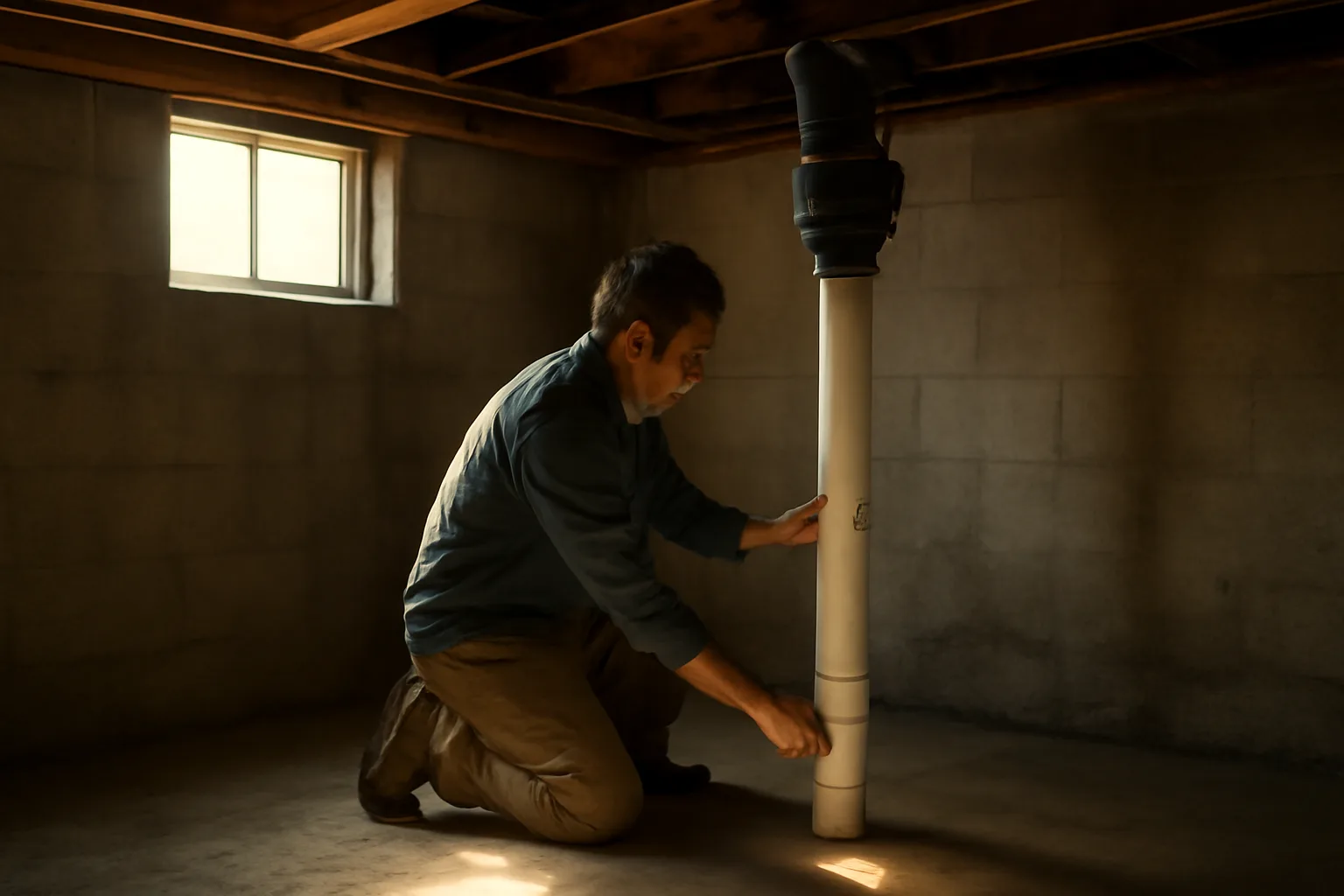
Most existing homes get an active soil depressurization system. A fan pulls from under the slab or from under a crawl membrane and dumps that air above the roof. EPA's Consumer's Guide to Radon Reduction treats this family of systems as the usual fix for a finished house [1].
EPA's health page is blunt. "Radon is the number one cause of lung cancer among non-smokers, according to EPA estimates," and it is the second leading cause of lung cancer, responsible for about 21,000 lung cancer deaths every year [3].
Units in the United States are picocuries per liter. The chain is uranium in soil, then radium, then radon-222. The dose that matters comes from the short-lived progeny that stick in the lung. You can install a good system without lecturing people about alpha particles. You cannot install a good system if you think caulk is the system.
Sealing is a helper. EPA has said for a long time that sealing cracks is not a standalone fix [1]. If a sales script treats a tube of polyurethane as mitigation, that script is wrong.
Mitigation is also a paper product. The homeowner, the buyer, and the listing agent want a before number, a system description, and an after number. If you cannot produce those three things, you did a construction project, not radon mitigation.
Some jobs need drain-tile suction or block-wall suction. Those are still mitigation. They just fail more often if you treat them like a single pit in the middle of a garage slab. Price them as the harder work they are. A short method comparison will keep you from running one detail on every house.
How do you start radon mitigation?
You start by reading your state radon statute and the board's current application, then earning the national proficiency credential that board names (usually NRPP or NRSB mitigation). After that you buy defendable test and pressure gear, file the business and insurance the board lists, and take a simple slab job you can document. Confirm every fee with the board. There is no federal license.
People skip the statute and go buy a fan. That is backwards. Some states license the person. Some license the business. Some do both. A few still have no radon-specific license at all. Only the live board packet is the answer, and Facebook is not a board.
EPA points the public at two national proficiency programs, NRPP and NRSB, and EPA does not certify contractors itself [5]. Sit the mitigation exam the board names. Keep the PDF. You will attach it to applications, insurance forms, and real estate packets.
If you want a single map of the national forms, RadonPath sells a $149 one-time NRPP Mitigation Kit. You do not need it. The public EPA pages and the proficiency program's applicant page are enough if you actually read them [5][14].
Buy a calibrated continuous monitor you can defend in writing, a digital micromanometer, and smoke. The PVC comes after the paper. Get the liability policy the board or your attorney asks for. File the business name. Then take a small poured-slab house, not a split-level with a block wall and a wet crawl.
Your first year is a documentation year. A system that still reads under 4 pCi/L on an independent post-test is the product. Everything else is a local amendment. If you plan to work across a state line, read a license comparison before you print the second set of cards.
What radon level requires mitigation?
EPA recommends fixing a home at 4 pCi/L or more [4]. Between 2 and 4 pCi/L, EPA still says consider a fix. That is public health guidance, not a federal work order. No nationwide statute forces a homeowner to install a fan at 4.
EPA's action-level page states it in one line: "EPA recommends homes be fixed if the radon level is 4 pCi/L (picocuries per liter) or more." [4] That sentence is the one you will see in listing packets. Learn it. Do not embroider it.
WHO set a reference level of 100 Bq/m3, about 2.7 pCi/L [6]. Health Canada uses 200 Bq/m3, about 5.4 pCi/L [7]. If you write reports for anxious clients, know those numbers so you do not invent them on the phone.
| Authority | Level | What it is |
|---|---|---|
| EPA | 4 pCi/L | Recommended action level [4] |
| EPA | 2 pCi/L | Consider fixing [4] |
| WHO | 100 Bq/m3 (about 2.7 pCi/L) | Reference level [6] |
| Health Canada | 200 Bq/m3 (about 5.4 pCi/L) | Guideline [7] |
Some states write the EPA number into disclosure or into rental language. Florida's radon statute still carries the familiar notice that radon is a naturally occurring radioactive gas that may present health risks when it accumulates in a building [8]. A disclosure stamp is not a duty to mitigate, and it is not a contractor license.
For operators, the working number is still 4 pCi/L unless your board or the contract says otherwise. Design for well under that. A system that lands at 3.8 pCi/L on a windy Monday is a callback you already sold yourself. NCI's radon fact sheet is worth handing to a client who wants the cancer context without a sales voice [13].
How does a radon mitigation system actually work?
An active soil depressurization system puts the soil side under a slight negative pressure relative to the house. The fan runs all the time. Soil gas goes up the pipe instead of through the slab. That is the mechanism. Fancy language does not change it.
On a poured slab you core a suction pit, drop 3 inch or 4 inch PVC, seal the slab penetration, run the pipe outside or through a garage, mount an inline fan, and terminate above the roof edge with the clearances in the standard you are following [1]. A U-tube manometer on the riser shows the homeowner the system is pulling. If the fluid does not move, the system is not a system.
Crawl spaces often get a sealed membrane and suction under the plastic. Block-wall houses can need wall depressurization. That work is slower. Price it like it is slower.
EPA's Citizen's Guide still gives the simple origin story you will repeat in kitchens: "Radon is a radioactive gas. It comes from the natural decay of uranium that is found in nearly all soils." [12] The gas then moves up and into the house through cracks and other holes in the foundation. Your pipe is competing with those holes.
Passive stacks (pipe, no fan) show up in some new-construction details. They are not a substitute for a designed active system on an existing house that already reads 12 pCi/L. I would not sell a dead stack as mitigation of a hot basement. Waste of a trip and a roof jack.
Pressure field extension is how you know one pit is enough. A manometer and a test hole tell you more than a bigger fan will. If you skip that check, you are guessing. Guessing is how you meet the same homeowner twice.
Do you need a license to mitigate radon?
It depends on the state, and only the board's current page is the answer. Illinois requires a license to perform radon mitigation for compensation under the Radon Industry Licensing Act, 420 ILCS 44 [9]. Pennsylvania has required certification since the Radon Certification Act of 1987 [10]. Ohio runs radon licensing in Ohio Administrative Code Chapter 3701-69 [11].
Other states have no radon-specific license. You still need whatever contractor registration the city wants, and you still owe the homeowner a system that works. "No state radon card" is not "no rules."
Never tell a client you are "EPA certified." EPA does not certify mitigation contractors [5]. That phrase is a complaint waiting for a slow Tuesday.
Confirm fees, bond amounts, photo rules, and CE hours with the board before you write a check. Those numbers move. I will not invent them here, and a national blog that invents them is doing you a disservice.
Homeowner self-install rules are their own mess. Some license states carve out a person working on their own house. Some still want a permit. A real estate deal is the wrong time to find out. If the buyer wants a credentialed contractor and an independent post-test, that is the job, even if the statute would have let the seller hang their own fan.
If you are choosing a first state to hang a shingle in, use a state-by-state paper comparison and then open the statute yourself. Secondhand lists rot.
What certifications do states actually accept?
NRPP and NRSB are the two national proficiency programs EPA tells the public to look for [5]. Measurement and mitigation are separate credentials. A measurement card does not let you install fans. Do not blur them on your website.
NRPP's mitigation applicant page is the live checklist for that path. Read it the week you apply, not the week you remember you applied [14]. Some states run their own exam on top of the national card. Some accept either national card. Some want the national card plus a state-law quiz. The application is the map. Line by line.
Reciprocity is uneven. A card from one state is not a golden ticket in the next. I have watched people waste a season assuming a neighboring board would rubber-stamp their file. Call the receiving board. Get the answer in an email you can save.
Keep CE certificates in a folder you can find. Boards ask at renewal. If you cannot produce the file, you do not have the credit. That is the whole rule.
National proficiency is not a substitute for a state license where the statute requires both. Illinois, Pennsylvania, and Ohio are the easy examples because the duty is written down [9][10][11]. Your state may look nothing like those three. Confirm it. A certification comparison is a start, not a substitute for the board PDF.
What does first-year radon mitigation look like on paper?
A clean job file has the pre-mitigation test (device, serial, placement, closed-house conditions), the proposal, a floor sketch with suction points, the fan model and serial, photos of the slab seal and the roof termination, the manometer reading at startup, and an independent post-mitigation test. That pile is the job. The pipe is how you earned the right to print it.
Write to a named standard even if your state never says the letters AARST out loud. Electrical work still follows the local inspector. Roof flashings still follow whoever warrants that shingle. If you only follow a video, your file will look like a video.
Invoices should name the fan, the suction type, and the post-test rule. Verbal "it will be fine" is how you lose a closing and then your Saturday. Home inspectors will ask for your state number and your NRPP or NRSB number. Put both in the footer of the PDF so you stop typing them.
Closed-house conditions are not optional theater. If the pre-test was two days with the windows shut, do not let the post-test happen during a renovation party. You will get a number that means nothing, and you will argue about it for a month.
Nobody has good public data on first-year callback rates by fan model or by house type. The closest thing you will get is your own log. Keep it. A shop that cannot tell you its own rework rate is guessing with your week.
How much does a typical mitigation job cost?
EPA's 2016 Consumer's Guide to Radon Reduction stated a typical mitigation cost range of about $800 to about $2,500, with an average of about $1,200 [2]. That is EPA's published range from that guide, not a 2026 bid survey. Labor, fans, and fuel moved. Use the EPA band as a historical benchmark and price the house in front of you.
A simple slab, one suction point, and an exterior fan can still sit near the low end of that band in some markets. Interior fans in finished space, multiple suction points, a drain-tile tie-in, or a large crawl membrane leave that band. I would not quote the national average on the phone. Walk the house.
I would not race to the bottom on price. Cheap fans fail. Callbacks eat the job. Charge for diagnostics. A smoke test and a pressure-field reading will save you a second day more often than a louder fan will.
Tell the homeowner the operating cost in honest hedges. A continuous fan uses electricity. EPA's guide discusses operating cost as a real line, not a footnote [1][2]. Your utility rate is local. Do not invent a monthly dollar figure you cannot show.
If you need a feel for how other shops talk about scope versus price, read a cost comparison and then ignore any number that does not name the house type.
What equipment do you need on day one?
The minimum kit I would actually buy is one professional continuous radon monitor with a current calibration certificate, a digital micromanometer, smoke, a hammer drill that can core a slab, PVC in 3 inch and 4 inch, two proven radon fans whose pressure curves you have read, an exterior-rated disconnect, U-tube manometers, polyurethane, and labels that match the standard you cite.
Skip a stack of cheap charcoal bags as your only quality control. They have a place in some measurement protocols. They are not how you diagnose a weak pressure field under a slab.
A thermal camera is nice. It is not year-one critical. A good manometer is. Calibrate on the schedule the manufacturer and the board name. An expired cal sticker makes a perfect install look sloppy in a complaint file.
You do not need five fan brands in month one. Learn one or two curves and a couple of pipe layouts. Buying a wall of unused plastic is a hobby, not a startup plan.
Permits and electrical parts are equipment too. If the city wants a licensed electrician on the circuit, budget that person. Cutting that line is how you meet an inspector you will not enjoy.
Who should run the post-mitigation test?
Someone other than you, when the state or the contract allows it. EPA's public guidance and most real estate channels want an independent post-test [1][5]. You installing the fan and then certifying your own 0.9 pCi/L reading is how you look captured.
Follow the device protocol and your state measurement rules. A common pattern is a two-day continuous test after the house has been closed. That is a pattern, not a universal law. The device manual and the measurement credential win.
If the post-test is at or above 4 pCi/L, you go back [4]. That is the job. Budget a callback. Do not look shocked.
Tell the homeowner to leave the system on. A mitigation fan is not a seasonal appliance. If they unplug it to save a few kilowatt-hours, the number will climb and they will call you like the pipe failed.
Keep the post-test with the fan serial in one PDF. Six months later, that is the file the buyer's agent wants, not your memory of a Tuesday.
Which standards actually govern a residential system?
EPA publishes public guidance. It is not a building code [1][12]. ANSI/AARST soil-gas mitigation standards for existing homes are what serious shops write to, even in states that never name the standard in statute. If your state adopted a specific edition, that edition wins. Confirm the edition year with the board. I will not guess it for you.
Electrical work follows the NEC as the local inspector applies it. Roof flashings follow the roofer's warranty if you want that roof to stay under warranty. Combustion-appliance safety is not a radon sidebar. A new vacuum in a tight basement can pull flue gas. Check it. If you do not know how, do not start that house.
New homes may fall under different soil-gas provisions than existing homes. Do not mix a new-construction passive stack with an existing-home active system in your head. Different details. Different callbacks.
Florida's s. 404.056 is a useful reminder that a health notice in a statute is still not a mitigation specification [8]. Ohio's Chapter 3701-69 is a licensing and practice chapter, not a pipe schedule [11]. Read both kinds of documents. They do different jobs. A standards comparison helps only after you have opened the one your board named.
What first-year mistakes waste real money?
Buying three brands of fan before you understand pressure field extension. Bidding crawl-plus-block houses like simple slabs. Skipping the independent post-test. Printing "EPA certified" on the van [5]. Ignoring the electrical permit. Letting a helper run a system with no sketch.
Paying a lead mill for exclusive radon leads before you can schedule a job in five days is another way to burn cash. Angry sellers will not wait for your learning curve.
Underbidding diagnostics is the quiet one. The extra hour with a manometer is cheaper than a second day of pipe. Every time.
Do not build your year on a national myth that EPA licenses you, that 4 pCi/L is a federal order, or that one price fits a county. EPA estimates about 21,000 U.S. lung cancer deaths a year from radon [3]. That is why the work exists. It is not why your invoice should be a guess.
If you want a punch list of paper errors shops keep repeating, use a first-year comparison and then audit your last three files against it.
How do state rules differ from the EPA talking points?
EPA sets a recommended action level and publishes how-to guides [1][4]. States decide who may take money to install a system. That split is the national myth. People hear "EPA says 4" and think there is a federal license. There is not [5].
Illinois writes a license duty into 420 ILCS 44 [9]. Pennsylvania did it in 1987 [10]. Ohio put the machinery in OAC 3701-69 [11]. Other states point at NRPP or NRSB and stay out of the way [5][14]. Your insurance carrier may be stricter than your state. Read the policy.
Disclosure laws are not mitigation licenses. Florida's radon notice in s. 404.056 is a real estate stamp, not a contractor card [8]. Do not confuse them in a listing packet.
HUD and the GSEs change radon language in mortgagee letters. Confirm the current letter before you tell a seller that FHA requires a system. I will not invent a live FHA duty here. Those pages move.
RadonPath is an independent publisher, not a law firm and not a mitigation company. For a form map on the NRPP mitigation path, start at /start. Still confirm the live board fee yourself. If a number is not on the board PDF the day you apply, it is not your number.
Frequently asked questions
What is radon mitigation?
Radon mitigation is any set of building changes that lowers indoor radon, usually by active soil depressurization. A fan pulls soil gas from under a slab or crawl membrane and vents it above the roof. Sealing cracks alone is not mitigation. EPA treats active soil systems as the usual fix for existing homes.
How do you start radon mitigation?
Read your state statute and the board's current application first. Earn the NRPP or NRSB mitigation credential if that board names one. Buy a calibrated monitor and a manometer you can defend. File insurance and the business name. Take a simple slab house and document the before number, the system, and an independent after number. Confirm every fee with the board.
Is radon mitigation the same as radon testing?
No. Testing measures the concentration. Mitigation changes the building so the concentration falls. They are separate national credentials. A measurement card does not authorize fan installation in states that split the work. Real estate deals usually want an independent tester after the system is in, not the installer certifying their own result.
What is the EPA radon action level?
EPA recommends homes be fixed if the radon level is 4 pCi/L or more, and says to consider a fix between 2 and 4 pCi/L. That is guidance, not a federal installation order. WHO uses a 100 Bq/m3 reference level, about 2.7 pCi/L. Design systems to land well under 4 so a windy retest does not become a callback.
Can I mitigate my own house without a license?
Sometimes. A few license states exempt a person working on their own home. Others still want a permit or a credentialed contractor. Confirm with the board and the city, not a forum. In a sale, buyers and lenders often want a listed professional and an independent post-test even if a self-install would have been legal.
How long does a mitigation system take to install?
A straightforward poured-slab house is often a single day for an experienced crew once parts are on site. Crawl membranes, block walls, interior finished routes, and electrical permit waits add time. Nobody should promise a calendar from a photo. Walk the house, then schedule. Post-testing still needs closed-house time after the fan is running.
Do mitigation systems run all the time?
Yes. An active soil fan is meant to run continuously. Unplugging it to save power lets soil gas return. Show the homeowner the manometer and tell them a stalled fluid column means a call, not a reset next spring. Operating cost is electricity plus occasional fan replacement, not a seasonal on-off cycle.
What is a good post-mitigation radon reading?
Under the EPA action level of 4 pCi/L is the usual contract target in the United States. Better shops design for a cushion under that, because weather moves short-term tests. Follow the device protocol and state measurement rules. If the independent post-test is at or above 4 pCi/L, the installer goes back and adjusts the system.
Is sealing cracks enough to fix radon?
No. EPA treats sealing as a helper step, not a standalone system. Caulk fails, concrete moves, and soil gas still finds a path. Use sealant at the pipe penetration and on accessible openings because it helps the fan, not because it replaces the fan. A caulk-only bid is a warning sign.
What is the difference between NRPP and NRSB?
They are the two national radon proficiency programs EPA points consumers toward. States that license often accept one, the other, or both. Measurement and mitigation are separate cards inside each program. Reciprocity with a state license is a board question, not a logo question. Read the live applicant page the week you apply.
Does FHA require radon mitigation?
Do not answer that from memory. HUD puts radon duties in mortgagee letters, and those letters change. Confirm the current HUD letter and the lender's overlay before you tell a seller a system is required. A high test can still make a buyer demand a fix even when the federal letter is quieter than the listing agent claims.
How often should a radon system be checked?
Look at the manometer regularly. If the column is flat, call. Recheck radon after major weather shifts, after house tightening, and when a fan is replaced. Follow any interval your state or the original contract named. An expired monitor calibration on a "checkup" is not a checkup. Confirm the device certificate first.
Can a radon system affect combustion appliances?
Yes. A new vacuum in a tight basement can spill a water heater or furnace. Check draft after the fan is on, especially with naturally drafted appliances. If you do not know that test, do not start that house. This is a safety issue, not a radon upsell. Local mechanical rules still apply.
What pipe size do most homes use?
Residential active systems commonly use 3 inch or 4 inch PVC, sized to the fan curve and the suction network, not to habit. A long run, a tight pit, or several branches can need the larger pipe. Follow the standard you cite and the fan's published curve. Guessing pipe size from a neighbor's house is how you buy a second fan.
Sources
- U.S. EPA, Consumer's Guide to Radon Reduction: Active soil depressurization is the usual mitigation approach for existing homes, and sealing alone is not a standalone fix.
- U.S. EPA, 2016 Consumer's Guide to Radon Reduction (PDF): EPA published a typical mitigation cost range of about $800 to about $2,500, with an average of about $1,200.
- U.S. EPA, Health Risk of Radon: EPA estimates radon is the second leading cause of lung cancer and is responsible for about 21,000 U.S. lung cancer deaths every year.
- U.S. EPA, What is EPA's Action Level for Radon?: EPA recommends homes be fixed if the radon level is 4 pCi/L or more, and to consider fixing between 2 and 4 pCi/L.
- U.S. EPA, Find a Radon Test Kit or Measurement and Mitigation Professional: EPA recommends certified professionals through NRPP or NRSB and does not itself certify mitigation contractors.
- World Health Organization, Handbook on Indoor Radon (2009): WHO proposes a reference level of 100 Bq/m3 (about 2.7 pCi/L) to minimize health hazards from indoor radon.
- Florida Statutes s. 404.056 (2023): Florida law includes required radon notification language for certain real estate and building contexts.
- Pennsylvania General Assembly, Radon Certification Act, Act 1987-43: Pennsylvania has required radon certification since the 1987 Radon Certification Act.
- Ohio Administrative Code Chapter 3701-69: Ohio regulates radon licensing and practice in OAC Chapter 3701-69.
- U.S. EPA, A Citizen's Guide to Radon (2016 PDF): Radon is a radioactive gas from the natural decay of uranium found in nearly all soils.
- National Cancer Institute, Radon and Cancer: Prolonged indoor radon exposure increases lung cancer risk.
- AARST-NRPP, National Radon Proficiency Program: NRPP is a national radon proficiency program with a separate mitigation credential and applicant checklist.