Last updated 2026-08-20
TL;DR
Radon mitigation is the work of lowering indoor radon, usually with a fan-powered soil suction system. You start by reading your state board, not a national myth. Some states license the trade. Others do not. Get the credential your board names (often NRPP or NRSB), take the approved course, pass the exam, then pull local permits and install to the standard the board cites. Confirm every fee and form with that board.
What is radon mitigation?
Radon mitigation is the set of building changes that lower indoor radon gas, most often a sealed pipe and fan that pull soil gas from under a slab or from a crawl space and dump it outdoors. It is not air freshening. It is not a test kit. It is mechanical work on the soil-gas path.
Radon is a radioactive gas. It forms when uranium in soil and rock decays. It moves with soil gas and collects in houses. EPA attributes about 21,000 U.S. lung cancer deaths each year to radon (U.S. EPA, Health Risk of Radon). EPA also names radon the second leading cause of lung cancer after smoking. [1]
The World Health Organization puts the source in one sentence: "Radon is a naturally occurring radioactive gas which may be found in indoor environments such as homes, schools, and workplaces." [2]
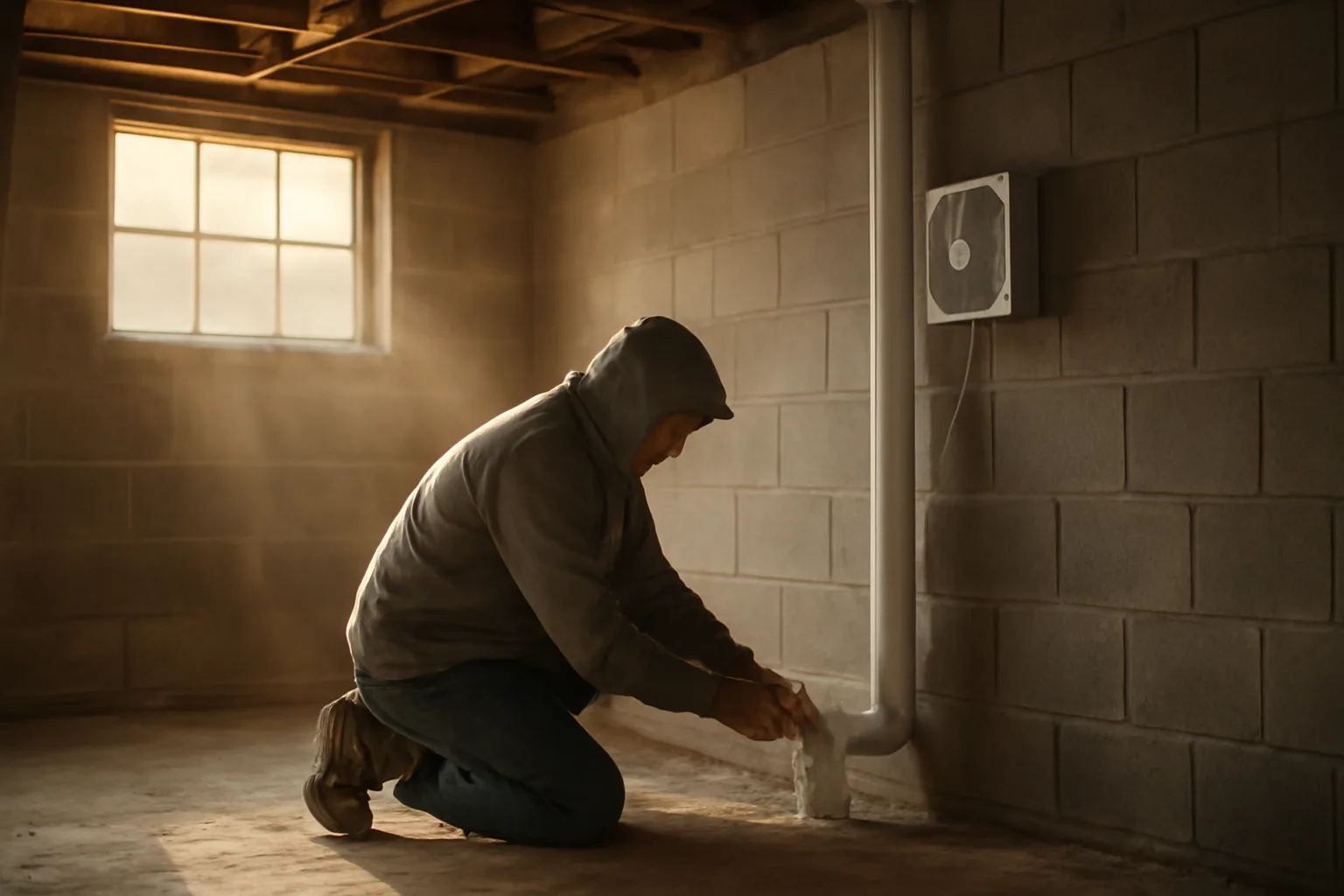
In the field, mitigation usually means active soil depressurization. You close obvious openings in the slab or membrane. You run a pipe to a suction point. You add a fan that runs all the time. You discharge above the roof eave, away from openings. You leave a manometer so the next person can see the system is pulling. That is the job homeowners mean when they say they got radon mitigation.
Other methods exist. Crawl space membranes with suction. Block-wall suction on some foundations. Drain-tile suction when the tile is already there. Pressurization is rare in houses and I would not lead with it. Sealing alone is not a system. EPA's consumer guidance treats sealing as a weak standalone fix. [3]
Congress set a goal stricter than the action level people quote. The Indoor Radon Abatement Act states: "The national long-term goal of the United States with respect to radon levels in buildings is that the air within buildings in the United States should be as free of radon as the ambient air outside of buildings." [4] Nobody in the trade pretends every house hits outdoor background. The goal is still on the books.
If you are entering the trade, mitigation is the install and the paper around the install. Testing is a different credential in most rulesets. Do not blur them.
How do you start radon mitigation?
You start radon mitigation by reading the board that can fine you, then taking the course and exam that board named, then pulling local permits before you cut a slab. There is no federal radon mitigation license. A national credential is not a license unless your state says it is.
Here is the order I would actually use.
First, find whether your state licenses radon mitigation. Illinois, Ohio, Pennsylvania, Kansas, and Florida all put the work in statute or administrative code. [5][6][7][8][9] Other states do not. If your state licenses, that packet is the whole game. If it does not, you still need a proficiency credential if you want insurance, realtor work, and a defense when something fails.
Second, take an approved mitigation course and sit the exam the board or the national program lists. Course length is not one number. I have seen boards talk in terms of a multi-day mitigation class. Confirm hours and the current provider list with the board. Do not buy a course that cannot tell you which exam it feeds.
Third, collect the paper the application asks for. Photos, affidavits, insurance certificates, and device lists show up a lot. Fees change. I will not invent a fee here. Read the current fee page.
Fourth, treat the city or county as a second boss. A soil-gas fan and a roof discharge are building work. Many AHJs want a mechanical or building permit even when the state radon office is quiet.
Fifth, install to the standard your board named. In most of the U.S. that is an ANSI/AARST soil-gas mitigation standard, not a YouTube playlist. [10]
If you plan to work across state lines, read each board. The radon mitigation board in Arizona is not a copy of the radon mitigation board in Connecticut. Reciprocity, if it exists, is a board decision, not a vibe.
What radon number actually triggers a fix?
EPA recommends homes be fixed if the radon level is 4 pCi/L or more. That is the number inspectors, lenders, and most U.S. contracts still use. WHO proposes a reference level of 100 Bq/m3, which is about 2.7 pCi/L.
EPA's wording is blunt. On its health-risk page, EPA recommends homes be fixed if the radon level is 4 pCi/L (picocuries per liter) or more. [1] EPA also says to consider a fix between 2 and 4 pCi/L. That consider band is where a lot of sales talk gets sloppy. A contract should say which number the client wants, and which test protocol produced it.
WHO's fact sheet proposes a reference level of 100 Bq/m3 and says countries that cannot meet that should not exceed 300 Bq/m3. [2] 100 Bq/m3 is about 2.7 pCi/L. If you work only to 4.0 and never mention the lower band, you will look dated to some public-health readers and normal to most U.S. real-estate files. Know both numbers.
Test type matters. A two-day charcoal test is not the same evidence as a 90-day alpha-track test. EPA's citizen guidance walks through short-term and long-term options. [11] I would not bid a mitigation off a single short-term test taken during a weird weather week if I can help it. Sometimes the contract clock does not give you a choice. Write the limitation down.
Conversion is simple enough to keep in your head. 1 pCi/L equals 37 Bq/m3. So 4 pCi/L is 148 Bq/m3. People mix units on purpose in sales decks. Don't.
Nobody has perfect house-by-house cancer data. The closest national figures people cite are EPA's 21,000 deaths per year estimate and the National Academy of Sciences BEIR VI risk models that sit behind a lot of that work. [1][12] Use them as population risk, not as a promise to one client.
Do you need a state license or is NRPP enough?
You need a state license if your state built one. You need a national proficiency credential if you want to work where there is no license, or where the license sits on top of NRPP or NRSB. You do not need a fake federal mitigation license. That product does not exist.
Illinois runs a dedicated radon service-provider rule set under 32 Ill. Adm. Code 422. [5] Ohio licenses radon testers and mitigation specialists under Ohio Administrative Code Chapter 3701-69. [6] Pennsylvania certifies radon services under 25 Pa. Code Chapter 240. [7] Kansas put certification in K.S.A. 48-16a01 and the sections that follow. [8] Florida's radon program sits in section 404.056, Florida Statutes, including the real-estate radon notice. [9]
Those five are not the full U.S. list. They are the ones I can put a statute number on in this article. Other states license too. Some do not. California is a common example of a large market where people keep looking for a radon board that works like Illinois and do not find one. Confirm current status on the radon mitigation board in California page and with the state radon office, then check whether the contractors board cares about the fan and the wiring.
| Paper | What it lets you do | Who issues it |
|---|---|---|
| State mitigation license | Offer the work where the statute requires it | Named state program |
| NRPP or NRSB credential | Show proficiency many boards and insurers recognize | NRPP or NRSB |
| Local building permit | Cut, wire, and discharge on that property | City or county AHJ |
NRPP (National Radon Proficiency Program) and NRSB (National Radon Safety Board) issue credentials. They are industry proficiency bodies. A lot of unlicensed states, plus a lot of licensed ones, point at one or both. Read the named list. If the board says NRPP Mitigation Specialist, do not show up with a random online badge.
I would get the national credential even in a quiet state. Insurers and listing agents understand it. A license from a state you already left does not travel unless the next board says it does.
What training and exams do boards actually ask for?
Boards want an approved mitigation course, a passing exam score, and whatever application exhibits they listed this year. Hour counts and exam vendors change. Confirm both with the board and with NRPP or NRSB before you pay a school.
I will not invent a clock. Some states publish a minimum training hour figure in the same chapter as the license. Some just say NRPP approved and stop. If a sales page quotes a single national hour requirement, treat it as marketing.
The course should cover soil-gas entry, diagnostic pressure field extension, fan sizing at a basic level, discharge rules, electrical disconnects, labeling, and the standard your board named. If the class skips diagnostics and jumps to drill one hole and hope, pick another class.
Exams are closed-book in the programs I would trust. Bring the ID the candidate handbook names. Remote proctoring rules are picky about the room. That is boring and it still fails people.
After the exam, you are not done. Licensed states often want a separate state application, a fee, and sometimes documented installs. I have no honest national number for processing time. Anyone who guarantees a date is guessing. Confirm with the relevant board.
If you already hold a measurement credential, do not assume it converts. Testing and mitigation are split in Illinois, Ohio, and Pennsylvania's chapters. [5][6][7] Dual credentials are normal. Dual does not mean automatic.
For Alaska or Hawaii demand is thin, but the paper question is the same. Read radon mitigation board in Alaska before you spend on a flight and a fan inventory.
What paper do you collect before the first install?
Before you cut a slab you want a signed contract, a test report you can defend, local permit approval if the AHJ requires it, and the license or credential number your ads already claimed. Skip any of those and you are doing construction, not a radon job.
Paper I would actually collect:
Client packet: address, foundation type, the test that triggered the bid, the target number (4 pCi/L or a lower number the client picked), access notes, and who pays if the first design misses.
Board packet: current license or credential, insurance certificate, and any employee list the state wants. Illinois and Pennsylvania both care who is in the house doing certified work. [5][7]
Jobsite packet: permit card if issued, product sheets for sealants if anyone asks, and the standard you are installing to.
System packet you leave behind: fan model, pipe layout, suction point, discharge location, manometer reading at startup, and a clear notice that the fan must stay on. EPA's consumer guide expects homeowners to understand operation and follow-up testing. [3]
If you want a pre-stacked paper packet, RadonPath sells a $149 one-time NRPP Mitigation Kit. You can also print the board PDFs yourself and skip the kit. The board does not care which binder you used.
Do not invent a current application fee in your ads. Boards change fees. Render every dollar amount as confirm on the current fee page.
Photos of the open slab and the finished discharge save you when a homeowner says you never came. That is not required everywhere. I still take them.
How much does a mitigation system cost a homeowner?
EPA's Consumer's Guide to Radon Reduction states a typical radon mitigation system costs between $800 and $2,500. That range is old and still the figure EPA publishes for the public. Your bid will land where labor, foundation type, and the fan live today.
EPA's consumer guide is the document most reporters still quote. It says a typical system costs between $800 and $2,500, with an average cost of about $1,200. [3] I would treat $1,200 as a historical midpoint, not a 2026 bid. Crawl spaces, drain-tile tie-ins, and long interior runs cost more. Simple basement slabs in easy soil cost less.
You should not promise a post-mitigation number. You can promise a design that follows the standard, a running system, and a retest protocol. Houses lose the bet sometimes. That is why follow-up testing exists.
Operating cost is electricity plus eventual fan replacement. EPA discusses operating cost in the same consumer guide. [3] Fan life varies. I will not invent a mean time between failures.
If a lead asks you to match a $400 quote, you are looking at a one-pipe hope job or a mistake. I would walk. Cheap fans on a kinked 3-inch run are how this trade gets a reputation.
For your own startup costs, I will not invent a van, insurance, or license total. Those numbers are local. Price insurance with a broker who has written radon or specialty contractors. Price the license on the board fee page. Price the course with a school that is on the current approved list.
Which standard do you install to?
You install to the soil-gas mitigation standard your board or credentialing body named, which in much of the U.S. is an ANSI/AARST SGM document, not a vendor flyer. If the board is silent, ANSI/AARST is still what I would write into the contract.
EPA's radon standards of practice page points practitioners at the ANSI/AARST consensus standards for measurement and mitigation. [10] The details move when the standard is revised. Read the edition your board listed, not a summary blog.
What the standard is doing, in human terms: keep the suction on the soil side, keep the discharge from looping back into the house, keep the wiring legal, label the system, and document it. Pressure field extension is how you know the suction point is doing something. A pretty pipe with no field is a decoration.
Electrical work is where new operators get cocky. A fan needs a disconnect and a circuit that the AHJ accepts. If you are not the electrician of record, do not pretend. Hire one.
I do not like secret attic fans with no label and no manometer. They fail quietly. The next inspector calls it a defect. You get the phone call two owners later.
Schools, daycare, and large buildings are not house work. Florida's statute even singles out certain schools and care facilities for measurement duties. [9] If someone asks you to just do the school like a basement, stop and read the building-class standard and the state program. That is a different job.
How do you read your state board without getting conned?
You read a state board by opening the statute, then the administrative code, then the current application PDF. You do not read a Facebook group and call it research. If the PDF and the statute disagree, the board staff letter wins until a lawyer says otherwise. I am not that lawyer.
Start with the statute number. Florida is a clean example because section 404.056 is easy to pull and includes the radon disclosure text used in real-estate contracts. [9] Ohio's Chapter 3701-69 is the code you actually work from day to day. [6] Kansas put the policy call in K.S.A. 48-16a01. [8]
Then open the application and the fee page dated this year. That is where staff hid the photo background color, the bond, or the employee form. None of that belongs in a national blog as if it were eternal.
Watch for scope tricks. Some licenses cover measurement and mitigation. Some split them. Some exempt the homeowner from the license when they work on their own house, then still require a permit. Confirm the exemption language. Do not assume.
If you want state-by-state maps of the paper, use a board page and then the primary PDF it cites. The radon mitigation board in Colorado and the radon mitigation board in Georgia are different animals. So is the radon mitigation board in Florida. Colorado has a long public radon program history. Georgia's packet will not match it.
Reciprocity is a board form, not a handshake. I have watched people waste a winter waiting on a letter that the next state never promised.
What do first-year operations look like on paper?
First-year operations are a short list of repeatable files: every contract, every test that justified the bid, every permit, every photo, every post-mitigation result, and a log of fan models you left in walls. That is the business. The van is just how you get there.
I would keep a job folder that a stranger could audit. Name it by address and date. Put the pre-test, the bid, the signed scope, the permit, the startup manometer reading, and the post-test in the same place. If a state asks for an annual report, you will already have the raw material. Pennsylvania and other certified states have been known to want records you can actually produce. [7]
Do not promise 48-hour installs in your first quarter. You do not know the permitting desk yet. You do not know which slabs are rubble. Variable facts like turnaround belong in a conversation with the AHJ, not on a homepage.
Hiring is a license problem before it is a help-wanted problem. If the code says certified individuals perform the work, your helper is not a loophole. Read the supervision section. Illinois and Ohio both care about who is certified. [5][6]
Marketing that says EPA certified is sloppy. EPA does not certify private mitigators the way it did decades ago. NRPP grew out of that history. Say NRPP, NRSB, or the state license. Say it accurately.
Cash flow is ugly if you buy a mountain of fans before you have three signed jobs. I would stock one common fan family and one pipe size you can buy locally at 6 a.m. Expand after the third paid crawl space, not before.
What is a waste of money when you start?
A national license in a box that never opens your state code is a waste of money. So is a wrapped van, a second credential you cannot use, and any course that will not name the exam. Buy the standard, the approved class, insurance, and a drill you can service.
I would not pay for lead lists of hot ZIP codes in year one. EPA's map of radon zones is public. [13] Zone 1 means higher potential, not a guaranteed 4.0 in every basement. You still test.
I would not buy a franchise story that quotes a guaranteed processing time. Boards do not give publishers that power.
Multi-state packages are only useful if you will file in those states this year. Sitting on six unused IDs is a renewal trap.
Skip the custom app. A shared drive and a paper permit sleeve beat a half-built CRM when you have eleven jobs.
Do buy the current ANSI/AARST standard, a micromanometer you trust, and legal review of your contract if you can stand the invoice. [10] The contract review is not glamorous. It is how you survive a missed target.
If you work a thin market, read the radon mitigation board in Alabama notes before you price a four-hour drive as if it were a city callback.
What should you confirm with the board every time?
Confirm the license trigger, the accepted credentials, the current fee, the application exhibits, and whether homeowner work is exempt. Confirm it on the dated PDF, not on a podcast. No article, including this one, can freeze a board fee or a processing clock.
Call or email the radon program with the statute section in the subject line. Staff answer faster when you cite 3701-69 or 404.056 instead of a vague license question. [6][9]
Ask whether mitigation is licensed for a company, a person, or both. Ask which national exams they still accept. Ask whether a local permit is separate (they may send you to the building department). Ask how they want the system labeled.
Then ask the building department the permit question again. Radon offices and building desks do not always agree. The desk that can stop your inspection is the one that matters that morning.
Keep the reply email. When staff turns over, that email is your exhibit.
If you later add measurement, repeat the whole dance. The chapters split the work for a reason. [5][7]
Florida's disclosure sentence is worth knowing even if you never work there, because clients paste it into emails: "Radon is a naturally occurring radioactive gas that, when it has accumulated in a building in sufficient quantities, may present health risks to persons who are exposed to it over time." [9] That is statute talk, not a sales script. Do not puff it.
Near the end of your setup, if you want a start page that points at a kit and a board list, use /start. RadonPath is an independent publisher, not a law firm and not a mitigation company. Confirm every variable fact with the board that can fine you.
Frequently asked questions
What is radon mitigation?
Radon mitigation is mechanical work that lowers indoor radon, usually a fan and pipe that suck soil gas from under a house and dump it outside. It is not a test and it is not a furnace filter. Most U.S. house jobs are active soil depressurization on a slab or a sealed crawl space. You still need a post-mitigation test to know if the number moved.
How do you start radon mitigation?
Read your state radon statute and the current application PDF. If the state licenses the trade, that license is how you start. If it does not, take the NRPP or NRSB mitigation path the market actually recognizes. Then pull any local building permit before you cut concrete. Confirm fees, hours, and forms with the board. Nobody can honestly lock those for you in a national article.
Is there a federal radon mitigation license?
No. There is no federal radon mitigation license. Congress set a national goal in 15 U.S.C. 2661, and EPA publishes risk and consumer guidance, but private mitigators are credentialed by NRPP or NRSB and licensed only where a state built a program. Treat any ad for a U.S. government mitigation license as a myth.
What is the EPA action level for radon?
EPA recommends homes be fixed if the radon level is 4 pCi/L or more. EPA also says to consider fixing between 2 and 4 pCi/L. WHO proposes 100 Bq/m3, about 2.7 pCi/L. Write the number your contract uses. Do not let a sales script swap units on the client.
Do all states license radon mitigators?
No. Illinois, Ohio, Pennsylvania, Kansas, and Florida are examples with a statute or code chapter you can open. Other states have no dedicated radon-mitigator license. In those markets the paper path is usually NRPP or NRSB plus local permits. Confirm the current rule with the state radon office before you print business cards.
Is NRPP the same as a state license?
No. NRPP is a national proficiency credential. A state license is legal permission to offer the work in that state. Some boards accept NRPP as part of their application. Some ignore it and run their own exam. Carry the credential the named board listed, then file the state form if one exists.
Can a homeowner mitigate their own house?
Sometimes. A few licensed states exempt a person working on their own dwelling. The exemption, if it exists, is in the statute or code, not in forum advice. The city may still want a permit. A later buyer may still want a credentialed system. Read the exemption text and the AHJ rules before you cut your own slab.
How much does a radon mitigation system cost?
EPA's Consumer's Guide to Radon Reduction states a typical house system costs between $800 and $2,500, with an average of about $1,200. That is EPA's published public figure, and it is dated. Crawl spaces and odd foundations run higher. A $400 quote is usually a bad design or a typo. Operating cost is electricity plus later fan replacement.
What is sub-slab depressurization?
Sub-slab depressurization is the common house method. A pipe reaches a suction pit under the concrete. A continuous fan pulls soil gas from that pit and dumps it outdoors above the roof line. A manometer shows the system is drawing. It only works if the slab and other openings are sealed well enough to hold a field.
Do I need a building permit for radon mitigation?
Often yes, even when the state radon office never mentions permits. A fan, a roof discharge, and a new circuit are building work. Ask the city or county building desk, not only the radon program. If the two offices disagree, the desk that can fail the inspection is the one that matters that morning.
Is radon testing the same credential as mitigation?
Usually no. Measurement and mitigation are split in Illinois, Ohio, and Pennsylvania, and NRPP treats them as separate credentials. A test kit business is not a mitigation business. If you want to bid the fix, get the mitigation credential the board named. Do not assume one exam covers both.
How do I find the radon board for my state?
Search the state statute and the health or emergency-management radon program, then open the application PDF those pages cite. EPA keeps a state-contact path, but the license rule lives in that state's code. If you need a mapped starting point, use a state board article and then click through to the statute it names. Confirm fees on the dated fee page.
What standard should a new mitigator install to?
Install to the edition your board or NRPP named. In much of the U.S. that is an ANSI/AARST soil-gas mitigation standard. EPA's standards of practice page points at those consensus documents. Write the standard name into the contract. Do not install off a vendor flyer or a video.
Can I work radon mitigation in more than one state?
Yes, if you file in each state that requires a license and you carry whatever credential the next board listed. Reciprocity is a form, not a handshake. Unlicensed states still care about local permits and about truthful advertising of NRPP or NRSB status. Budget renewals for every ID you keep active.
Sources
- U.S. EPA, Health Risk of Radon: EPA recommends homes be fixed at 4 pCi/L or more, names radon the second leading cause of lung cancer after smoking, and attributes about 21,000 U.S. lung cancer deaths each year to radon.
- World Health Organization, Radon and health fact sheet: WHO describes radon as a naturally occurring radioactive gas found in indoor environments and proposes a reference level of 100 Bq/m3.
- U.S. EPA, Consumer's Guide to Radon Reduction: EPA states a typical house radon mitigation system costs between $800 and $2,500, with an average cost of about $1,200, and discusses sealing limits, operation, and follow-up testing.
- 15 U.S.C. § 2661, Indoor Radon Abatement national goal: Federal law sets a national long-term goal that indoor air should be as free of radon as outdoor ambient air.
- Ohio Administrative Code Chapter 3701-69: Ohio licenses radon testing, mitigation, and laboratory services under OAC Chapter 3701-69.
- 25 Pa. Code Chapter 240, Radon Certification: Pennsylvania certifies radon services, including mitigation, under 25 Pa. Code Chapter 240.
- Kansas Revisor of Statutes, K.S.A. 48-16a01: Kansas enacted a radon certification law beginning at K.S.A. 48-16a01.
- Florida Statutes § 404.056 (2023): Florida's radon statute includes program authority, certain measurement duties for listed facilities, and the statutory radon disclosure text used in real-estate contracts.
- U.S. EPA, Radon Standards of Practice: EPA points practitioners to ANSI/AARST consensus standards as the radon standards of practice for measurement and mitigation.
- National Academy of Sciences, BEIR VI Health Effects of Exposure to Radon: BEIR VI is the National Academy risk assessment that underpins much of the U.S. population lung-cancer modeling for indoor radon.
- U.S. EPA, EPA Map of Radon Zones: EPA's radon zone map rates counties by predicted indoor radon potential and is public, not a substitute for a house test.